

No Surrender, No Retreat:
An Exploration of Maximalism and a Celebration of Bill Hollweg, Master Maximalist Audio Dramatist.
Written by Lothar TuppanPeople sometimes ask, ingenuously or otherwise, “Why do composers today want to write complex music?” Looking at the broad history of Western music I would be tempted to reply, equally simplistically yet not inappropriately, “When have the talented ones ever wanted to do anything else?”
–Richard Toop, “On Complexity”
Hmm. That’s quite the bombastic and aggressive quote to start off with isn’t it? Don’t worry, I’ll address its claims later so just put a pin in that for now.
It’s March and although there are many worthy areas of awareness associated with the month, including Folk Horror & Cryptid Month that we are celebrating here at Screaming Eye Press (1) March also marks the birthday of one of the best friends I ever had, and one of the best audio dramatists to ever weave sonic tales: the late Bill Hollweg.
In addition to being an accomplished guitarist, illustrator, writer, and voice actor, Bill showed his artistic mastery most explicitly as an audio drama producer. A number of Bill’s old friends and fellow audio dramatists decided to do something to honor Bill this year on the anniversary of his birthday (and please listen to the audio drama offerings over on the Mutual Audio Network (2) ). In addition to those audio treasures, I wanted to add a modest essay that would honor Bill and also, perhaps, start a more scholarly discussion about our art form, bringing it into the greater critical conversations about art. As I thought deeper about Bill’s approach to mixing and producing audio drama (an approach I also share since he was my main mentor as I was learning my art and craft), I realized that there was much that needed to be communicated; explained in such a way as to increase both understanding and respect—both within the theory of how he approached his art and in the experiential joy his voluminous body of art provides.
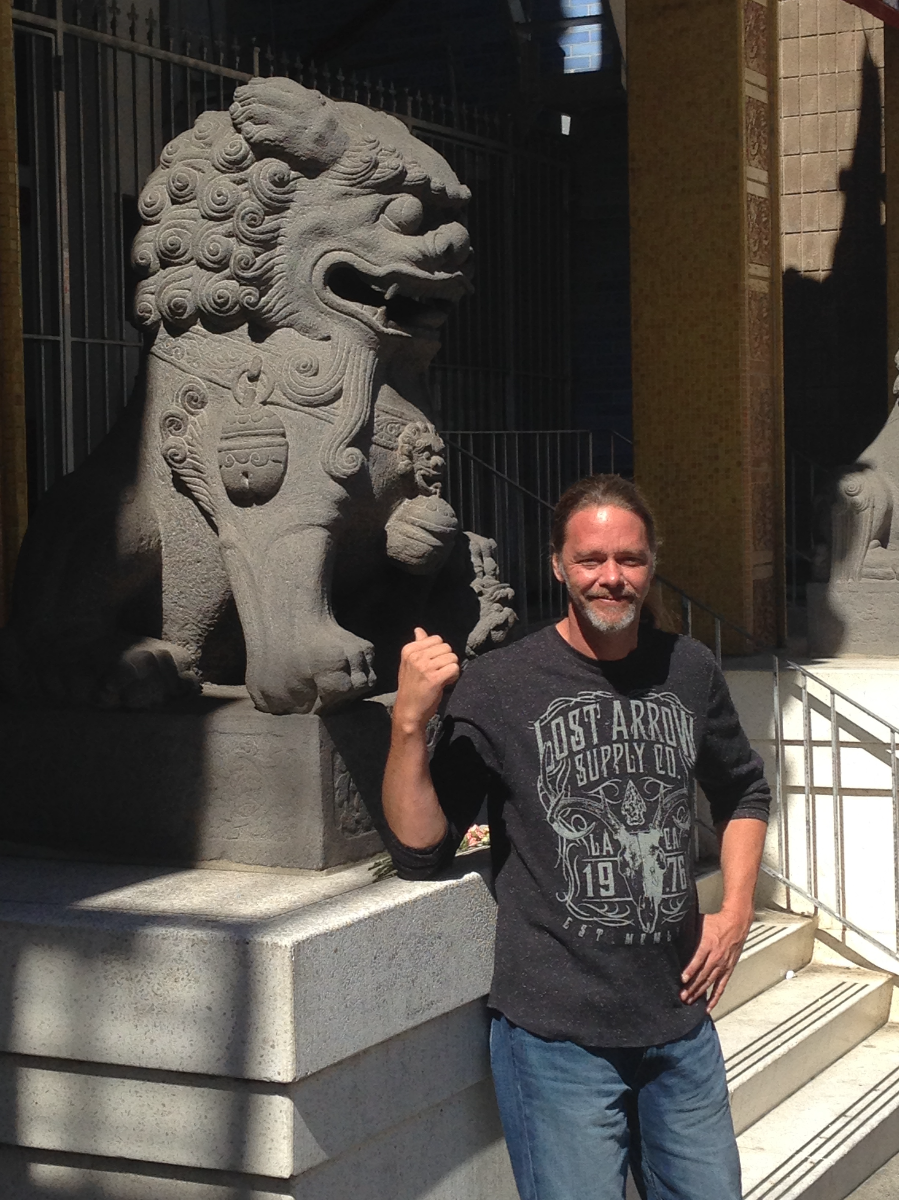
So, here I am with another Screaming Eye Press essay. This time about a philosophical and practical approach to creation that best describes the art that Bill loved to create. An approach that art theorists have termed “maximalism.”
One of my goals with these essays (3) is to explain what can be obscure genre and artistic terms in ways that enhance the readers’ or audience’s appreciation and enjoyment without redefining the understood and accepted meanings that might be taught in schools or used by critics—and this essay is going to touch on at least three of those (maximalism, minimalism, and essentialism). Also, as I consider myself a creator and receiver of art first and foremost and any sort of theorist second my approach is always toward the practical. There is so much in art theory (even more so than in just pedantic genre definitions) that can lead away from appreciation and understanding—much that gives truth to the quote from Nietzsche about how whenever one defines something they begin to lie about it (4). I’m aiming for clarity and empowerment instead of academic navel gazing which often leads away from a practical application. Because, if nothing else, Bill was always about actually making art that people would love to listen to, hopefully over and over again. Art that he simply would have called “groovy.”
Bill approached his art instinctually. When I would talk theory and philosophy, he would, in his deep gravelly Texan voice, say things like, “Never thought about it that way Amigo, but that makes perfect sense.” Or, “You’re the deep thinker Brother; I just do what I do.” And what Bill did was make some of the absolutely best audio drama I’ve ever heard.
Bill would never have used the term maximalist. He just would have said that he loved making “rich” or “dynamic” soundscapes. So why am I labelling him a maximalist? Because, that term is the most technically accurate I’ve encountered so far. I’ve never really liked previous terms I’ve heard applied to his (and my) style like: “overproduced” (which is just dismissive completely as it defines by its perceived sins); the “Every Blade of Grass” style of mixing (as defining by absurdity—asserting that people who produce in that style are trying to portray the sound that “every blade of grass” makes when someone is stepping on a lawn—is passive-aggressively pejorative in effect if not intent); or “Cinematic” (as defining through a term specific to another art form is indistinct and relegates audio drama to cinema’s wannabe sibling).
I’ve been familiar with literary maximalism to some degree for years but decided to dive deeper into the subject and that quickly led me to its use in film, music, and areas I was completely unfamiliar with such as maximalism in fashion. Maximalism in the varied arts all have slightly different meanings and definitions (5). I’ll address literature, film, and music here as they have similarities that are pertinent to audio drama, and I hope that professional art or media theorists will continue this discussion by listening to the wide variety of audio drama out there and add their own analyses and thoughts regarding our underappreciated yet resurging art form.
Although I am focusing specifically on maximalism, the term minimalism needs to be addressed as the two are commonly contrasted with each other. The two are not always linked so take what follows as a way to provide context, not to create a binary distinction that all art needs to fit into.
Based on feedback I received from some readers of early drafts of this essay, it is unfortunately necessary to state that if an audio drama isn’t a maximalist work I am not automatically defining it as a minimalist work. These definitions are not hard taxonomical boxes and there are many other styles and approaches that I am not covering here, including but not limited to: midimalism, romanticism, realism, modernism, postmodernism, surrealism, and plain old “I just make audio drama and damn your definitions”-ism. Also, many works have multiple approaches present at the same time. The production of the soundscape might be maximalist while the writing minimalist, or vice versa, or any combination of styles. In my own work, my plans and mixing style are more maximalist while my prose style leans more to the minimalist side of things. To any fellow audio dramatists reading this, I’m only defining Bill’s works. If I don’t mention your work by name, I’m not defining what you do.
Ok, back to our topic.
One thing that I think is misleading is that many sources state that literary and musical maximalism is a response to minimalism or a form of anti-minimalism. As far as I can tell this is too reductive because while minimalist literature is thought to have its earliest precursors in Stephen Crane (born 1871) and Ernest Hemmingway (born 1899), the first novel to use prototypical elements that would define literary maximalism was Melville’s Moby Dick; or, The Whale in 1851 with James Joyce’s Ulysses in 1922 as an early quintessential example of literary maximalism.
Similarly, musical minimalism is a postwar movement with Moondog (born 1916) influencing Philip Glass (born 1937) and Steve Reich (born 1936) who along with Terry Riley (born 1935) really defined minimalist music. Musical maximalism came earlier. Starting in the modernist compositions from 1890 to 1914 and developed independently owing much to other threads of musical evolution like Phil Spector’s “wall of sound” production method which I’ll touch on below.
The confusion lies, in my opinion, because, similar to “noir,” both “minimalism” and “maximalism” are terms created in postwar criticism applied retroactively to various contemporary and historical works.
While I’m sure there are individual artists from one approach that are “responding” to the other in some form or another, from a historical perspective I don’t think that either “movement” was a “response.” They are contrasting philosophical approaches to art with that contrast invites comparison.
When I first started writing this essay, I shared some initial thoughts with close friends and colleagues in life and in the audio drama community, who were also close friends with Bill (6). The question of how does the “essence” of a piece came into the discussion? What about “essentialism?” One person believes that the term essentialism works better than minimalism but there are a few reasons I reject that use, beyond my already stated priority of not redefining existing terms within art criticism.
My main reason is because naming any approach “essentialism” inherently implies that such a particularly defined approach has essential elements while others have non-essential or extraneous elements, this is similar to the previous charge of things being “overproduced.” It logically creates a semantic hierarchy of what is essential, intrinsically not just rhetorically, through the language used in the label “essentialism.” It also, fundamentally and logically, excludes contingency, and all art—and what is essential to a particular art piece—is always contingent.
Another key reason I reject that usage is because the term “essentialism” already exists and has a specific meaning and use. Art theory terms are already slippery enough without adding to the confusion of redefining existing terms. Especially, as the existing terms do work extremely well. Essentialism in the arts is an extension of platonic essentialism that posits that people, objects, etc. have core attributes that define their identity. The philosophical controversy around essentialism is that essentialism negates the individual’s ability to grow or change from free will as their nature was defined before they were born, including the parameters within which personal change can happen. But the pros and cons of philosophical essentialism is a whole other rabbit hole.
In the arts, essentialism is the belief that a strict set of aspects defines a type of art. With this school of thought, no art form can ever evolve and would just break into other definitions. Its definitional rigidity is unhelpful and focuses more on how to label a work instead of focusing on appreciating it for what it does.
Essentialism isn’t even a theory of artistic approach, it is more of a statement about the ontological state of the art in question. Also, as I mentioned above, it negates the ability to judge an art piece as contingent or within its particular context, which is abhorrent to me both as an artist and an art lover.
As we’ll see, maximalist and minimalist approaches are just that: approaches, not taxonomical absolutes. Both have what is essential to them as pieces of art. As do all other theoretical approaches to style. If one defines “essential” not as an intrinsic platonic property but as what is necessary for a piece of art to be effective and affecting, then, all art that touches someone is essentialist art.
Minimalism is often reductively defined by the ethos, “less is more” and maximalism by “more is more.” Throughout human art there have probably been people who fall on one side or the other of that divide. (Or neither. As mentioned above there are plenty of art pieces that qualify as neither maximalist nor minimalist.) While, when one has a better grasp of the specifics and nuances, the short-hand of “more is more” vs. “less is more” can be indices pointing to a greater definition, they can be too reductive and misleading when used casually. In literature, film, and music, what those contrasting ethos actually mean provides a clear distinction as I’ll explain below.
Another defining criteria is how they each use heterogeneity. Heterogeneity is the use of a great diversity of themes, styles, forms, media, references, prosody, etc. bringing them all together into new syntheses.
In literature, maximalist works are explicit, putting everything on the page with elaborate descriptions. The sumptuous, accumulating elements build into an ecstatic experience that provides many ways of reading the various meanings as the reader navigates the prose as an active explorer, finding many obvious voices, styles, discourses, references, and digressions.
Minimalist literature is implicit. It hides things between the lines. Lines with economic prose and matter-of-fact descriptions. It omits on purpose while allowing the reader to specify meaning. Meaning that will vary from reader to reader as each ends up being a co-creator. Hemingway is perhaps the best known proponent of this approach and his “iceberg theory” or “theory of omission” champions the implicit over explicit approach to writing fiction.
Minimalist films imply whole scenes, events, or worlds off-screen through a sparse visual field and prolonged edits. The viewer, through contemplation realizes suggested heterogeneity through a singular or focused narrative thread that is heavy with implications. Visuals can be rich and evocative but focused.
Maximalist films are dense with a rich excess of images, sounds, and plot threads that are delivered through rapid editing. Self-referentiality provides mythic context and the viewer is bombarded by a menagerie of images explicitly displaying the work’s heterogeneity. Visuals are rich through vibrant and concentrated variety.
Maximalist music is dense with often sudden and obvious shifts in movements, time signatures, and keys. The listener is absorbed—carried away by a wave of sounds, instruments, and explicit heterogeneity acting as a huge orchestra.
In music, minimalist works are sparse with gradual or small changes to time signatures or keys. The listener, through attention to what emerges over time, finds meaning and a piece’s heterogeneity is revealed subtly. Similar to literature, meaning is found in the silences.
For all the arts that I love, I do my best to truly appreciate and enjoy many different styles, forms, or approaches. It’s a rich world of so much beauty that I consider confining myself to a limited selection of types of genre, prose, film, or music to be anathema. So, in addition to the various styles not even mentioned in this essay, I love both minimalism and maximalism. I love Bret Easton Ellis and Herman Melville; Raymond Carver and Mark Z. Danielewski; Terry Riley and Jim Steinman; Philip Glass and Pink Floyd; John Cassavetes and Alejandro Jodorowski; Yasujirō Ozu and Terry Gilliam. Also, artists or their works don’t always fit into these definitions easily. Stanley Kubrick is a director that is maximalist in how he focuses on detail and in his general production approach while being minimalist in the way he conceives the shots and approaches his narratives (7).
Now that some foundations have been laid, let’s shift over to more specifics within the world of audio, both music and drama, and explore some of the things that define minimalism and maximalism there. Elements which, along with what I described above, should be seen less as essential aspects of those definitions but instead as aesthetic strategies. Strategies that could include the following while keeping in mind that not all of these have to be present. These elements should aid in understanding and appreciating. They should not be used to nail art taxonomically to a board like a dead butterfly. They should aid in appreciating the beauty of the butterfly flying, not just list what makes it what it was after its death. Also, as mentioned above, except in extreme examples many pieces of art will have several different approaches combined.
In audio, minimalism could include:
- Less information per moment, with more time (literal or experiential) spent within each moment. In musical minimalism this could include fewer pitches, chords, and harmonic movements with repeated arpeggios per measure(s). In audio drama this would involve fewer sound effects, distinct dialogue that isn’t layered with other voices or information, and naturalistic scenes that don’t have harsh or sudden cuts between them.
- Repetition as Structure. This is when repetition is the form and not just decorative, creating a feeling of small changes being exponentially important. Think of certain folk ballads where a refrain or chorus shifts near the end, either musically or lyrically, to enhance the tragedy or triumph of the narrative. Or, in minimalist classical music where such small changes create a powerful emotional resonance in the listener. The repetition can give a sense of cyclical or eternal time instead of directional/linear time. In audio drama this might be invoked by the repetition of musical stings for transitions or sonic set pieces used as refrains.
- Surface Clarity. Textures are easily heard and identified. Individual phrases are easy to track. Timbre is consistent or slowly evolving. In audio drama this would mean that dialogue or sound effects that were directly indexing important plot points would be the only or primary sounds present and, if other sounds are present they would be substantially lower in volume as to not compete with the dialogue.
- Heterogeneity is implicit. Heterogeneity, usually in the form of micro-variations, emerges slowly over time. Small rhythmic drifts and additions, harmonic and melodic alterations, etc. all occur in ways that make the aspects seem new or evolved without explicit dramatic shifts. In audio drama this would be even more understated and subtle. Perhaps a musical sting used for transitions would have a second phrase or measure providing closure at the end of a story, or a textual element in the foreground of the plot would have a subtle but important subtext made present during the climax or denouement, highlighting its importance through subtlety.
- Listener Immersion. The listener “settles into” the sound field. Attention commonly shifts from expectation to perception and the emotional response is often trance-like. More internal even in strong emotion. One might be moved to tears but not necessarily want to scream to the heavens. In audio drama the silences in the soundscape would cause the listener to “lean into” those silences to apprehend what may not be obviously apparent. The sparse sound field would create an intimacy that is qualitatively different than the immersive immediacy of a maximalist soundscape.
In audio, maximalism could include:
- More information per moment, with constant stimulation. Many themes, harmonies, rhythms, and timbres. Layered orchestration and production. Frequent and sometimes dramatic contrasts. In audio drama this would be immersive soundscapes with lots of diegetic sound effects that provide semiotic story elements that are more than just “realistic” sounds. The music, dialogue, background sound bed, and various sound effects all work together like instruments in an orchestra, carrying the listener through the scene.
- Narrative or Dramatic Drive. Almost every song with lyrics, in any approach, tells a story but in maximalism the music itself often is composed with the purpose of conveying story with strong elements of conflict and drama (8). All with a clear sense of arrival, climax, and release. Time is more directional and less eternal than in minimalism. As audio drama, by its nature, always tells a story, the pacing of the scenes and the way the various sonic elements occur in those scenes will be faster and will propel the story further than in a minimalist production. The non-dialogue based sounds directly drive the story as much as the dialogue does, in the way that rhythm can drive a melody in a song.
- Contrast as Structure. Juxtaposition of loud vs. soft, dense vs. sparse, fast vs. slow is present instead of being a gradual process. Surprise and excess are aesthetic virtues (9). In audio drama this could also include juxtaposition within the stereo field. Left vs. right or panning vs. static. Strong increases or decreases in volume as characters or objects fade in or out while moving through the stereo field.
- Textural Saturation. Multiple layers are present and compete for attention. Timbres are diverse and extreme. Orchestration is expressive and sometimes intentionally overwhelming. Within an audio drama scene this could include background ambience like a clock ticking or a fireplace crackling, while in the middle ground there could be a conversation by secondary characters (with information that isn’t vital but if focused on in a relisten could provide enriching subtext), while in the foreground there could be the drinking of liquids or eating of food while the primary characters engage in dialogue. Any of these characters or objects might also be moving (through panning and increases or decreases in volume) through the stereoscape creating a sense of dynamism in the scene.
- Heterogeneity is explicit. Multiple themes at once, rapid stylistic shifts, layers upon layers, and overlapping narratives, forms, or moods can all be maximalist approaches to heterogeneity. In audio drama this could include modern soundtrack music or short scenes with fast cuts and elaborate transitions in an Old Time Radio style show. Stories could have multiple genre elements in them like romance, intrigue, horror, action, and comedy all working together or providing a new perception that reveals through their combination.
- Listener Engagement. In both music and audio drama, the listener is pulled by the momentum, as if in a riptide or a fast-moving river. Emotional effect is far more ecstatic (in the anthropological sense of entering a state of overwhelming emotion, creating a shift in consciousness). Attention is participatory and anticipatory and more external. Those aforementioned tears might also be accompanied by the urge to dance, or rage, or sing along loudly with the music or cheer along with the story.
In some pieces of music, or any art, it can be extremely apparent as to whether something fits into either category or neither of them. In other times, for me, it depends on what the apparent or stated intent of the piece was and which elements drive and are crucial to conveying that intent.
A good film example would be the 1979 film Alien. It is both sci-fi and horror. But, most people recognize that the horror elements are more important and crucial than the science fiction ones. You could take the story and set it on a merchant marine ship with a religious demon as the monster set in 1979 and the story would still work. Take the horror elements out and you have merchant marines in space arguing about their overtime pay, or if they decided to lean into the sci-fi more explicitly and perhaps have the alien not be a threat, it changes the story completely. Using that criteria, Alien is more horror than sci-fi even though both are present.
Terry Riley is a definitive modern minimalist classical composer. While he can have dense layering of electronic synth music, it is more minimalist (and he’s almost the quintessential minimalist) because that layering is the same phrase repeated over and over in slightly different ways.
Richard Wagner is a classic maximalist composer. Even though there are times of silence or quiet progression which can seem minimal, his work brings in hundreds of recurring motifs that merge, transform, and even contradict each other and he directly merged music (that heterogeneous thing again) with stage design, philosophy, myth, psychology, etc. in interdependent ways.
And now, perhaps, is a good time to return to the epigraph from Toop I began with. If you read his full essay it’s clear he’s not being a pompous jerk with that statement but the reason I entered it here is because, despite this being an essay championing maximalism and Bill Hollweg’s expression of it, I don’t think that this type of complexity is the only type to be explored. Nor do I think that all talented audio dramatists should or need to increase their mixing complexity in maximalist ways. What I do think is that any creator does their best work when they push the edge of their abilities, when there is a danger of falling completely on your face. When the artist takes the attitude of “no surrender, no retreat.”
Complexity doesn’t mean complicated. It is what adds levels of beauty, richness, and the sublime to art. It creates multiple levels of meaning. It reflects the human condition in ways that illuminates the understanding of our lives and the lives of others (10).
Most of us audio dramatists are DIY creators, wearing many hats. For those who prioritize their acting, I think the talented ones will increase the complexity of their acting, where one line can convey a multitude of emotions, making us all wonder how they brought us to tears with a few simple words. Writers will increasingly complexify their text, subtext, allusions, themes, and characterizations, bringing us fully into their worlds—whether they write in a minimalist, maximalist, or completely different style. And those of us for whom sound design and mixing makes our tails wag will increasingly work to have complex soundscapes that immerse into story without obscuring it. Or, conversely the producer might take a minimalist approach and have the sparse sound design and silences speak more than any sound effect ever could, making us wonder how they added that complexity with such sparse elements.
I want to explore one last musical component to popular maximalism before moving on to Bill’s techniques and style. Something that emerged from Richard Wagner’s physical orchestral arrangements (where the musicians were literally physically “arranged” specifically within the Bayreuth Festival Theater to create an aesthetic effect for the audience) and later applied to American popular music was the term “wall of sound” (11).
As it applies directly to Bill Hollweg’s work, it was how this term was used to describe Phil Spector’s production style by Andrew Loog Oldham (12). Spector’s style would influence much of the pop, R&B, and rock that would follow. He increased orchestration, bringing in other instruments like strings and woodwinds. He used effects like echo, chorus, and reverb (and a lot more) but the main factor, more than the specifics, was in how the production of the final recording was intentional from the beginning of the process. It wasn’t an afterthought. It was similar to film directors who envision the final edits when shooting scenes. This approach is very similar to how maximalist audio dramatists might conceive of something before scripting even begins.
I remember Bill telling me when he was working on his science fiction epic, 2109: Black Sun Rising that he “heard” certain scenes—not just dialogue but the full soundscape—in his head before he even wrote them and did his best to manifest that in his notes for the final mix. I had something similar happen when I was first conceiving my sword and sorcery audio drama The Sword of the Crimson Tatters in that I “heard” the brief few paragraphs I wrote to be the core of the world, that ended up being the intro to each episode. In my mind the text was spoken with a multitude of voices all overlapping in different pitches and speeds. It took me a while to figure out how to make that into something produceable, but it was as essential to the whole piece as anything else. Interestingly, once I had that figured out, other things (both while writing and while mixing) moved almost effortlessly by comparison. For maximalists (and Bill in particular) the “mixing vat” (as we, old timers, used to call the post-production, audio editing, and mixing process) was one of the most important “instruments” in our “orchestras.”

Just as important as the general approach to production was the musical origin of that production process. A lot of the aforementioned hard and progressive rock that came out of that “wall of sound” approach would directly influence Bill’s style. Especially albums produced by Bob Ezrin who was known for his dense arrangements, layered instrumentation, orchestration outside of the core bands in question, choirs, detailed sound design, use of sound effects, and big dramatic arcs (13).
During one of our regular, long phone conversations, Bill and I reminisced about how some of our early “audio dramas” were actually concept albums like Pink Floyd’s The Wall, The Who’s Tommy and Quadrophenia, and KISS’s Music From: The Elder. This musical component, especially considering that Bill was a damn good guitarist, shouldn’t be under emphasized when listening to his work (14).
Speaking of Bill’s work, now is a good time to discuss some of the things that defined his personal voice and style as an audio dramatist.
I could care less about any award crap. I just love MIXING (specifically panning, making as rich and dynamic of a soundscape as possible, and all that), hanging with my Amigos, and having killer fun telling groovy tales!
–Bill Hollweg,
email correspondence to me in response to one of Bill’s shows being nominated for an Audio Verse Award
A little context for what many of us call the Golden Age of Modern Audio Drama (not to be confused with the Golden Age of Radio) will be useful. Since most audio drama producers, especially back in the mid-2000s to mid-2010s, had absolutely no budget, the choice of music, sound effects, and other sound elements were limited to either what was cheap and royalty free, public domain, given to the producer to use as a way of getting more exposure, or created by the producers themselves. Actors were lovers of the medium and often produced shows themselves, with many people acting in each other’s shows. It was a tight-knit and mostly open and welcoming community. Most of us were self-taught or taught by someone else in the community in exchange for helping them with their shows. It was an exciting “punk rock” era. It allowed for people to not only mimic the more dominant art forms they were inspired by but to also completely break with established patterns and accepted models and do their own thing, however they saw fit. This worked really well to Bill’s strengths as his style and direction was both instinctual as well as perfect for finding creative solutions to the limited resources I just mentioned.
Bill produced a wide variety of shows. He made fan adaptations or extensions of his favorite movies or tv shows, like Planet of the Apes, Logan’s Run, Battlestar Galactica, Jaws, and Escape From New York (the latter was adapted by Bill but mixed by Stevie K Farnaby). And he also produced original shows like his fantasy epic The Saga of the Grog and Gryphon, the action pulp serial Jake Sampson: Monster Hunter (which was a joint creation by Bill, Paul Mannering, and Mark Kalita), his science fiction epic 2109: Black Sun Rising, as well as numerous one-off audio plays.

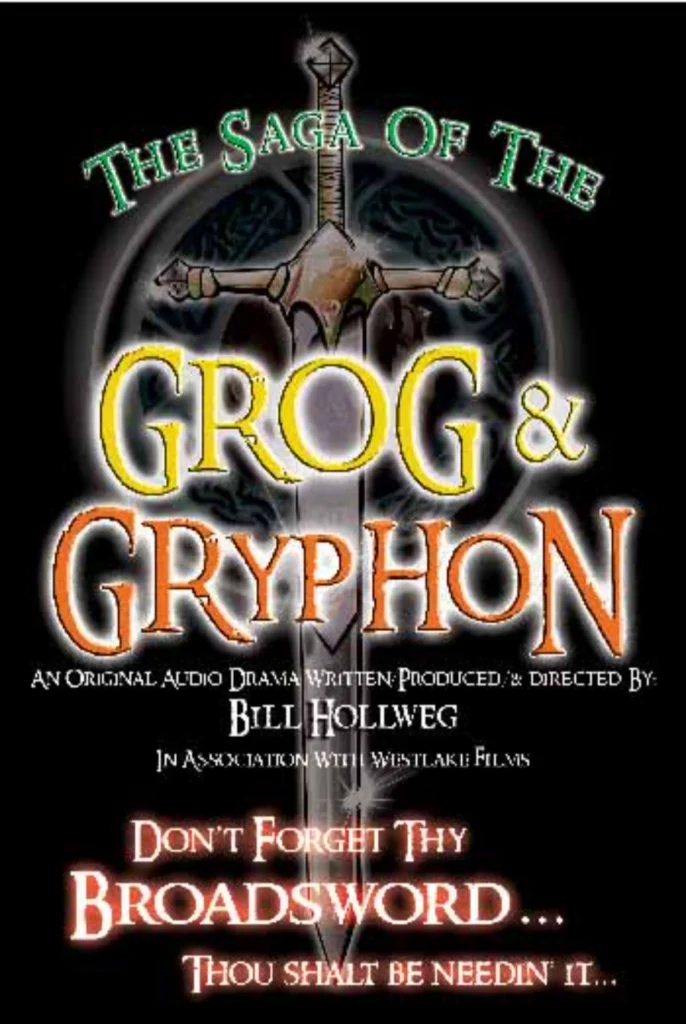
I’ll go through the maximalist criteria mentioned earlier and explain how Bill incorporated these into his production. Sometimes as a calculated decision, sometimes as the way his natural approach and style dictated, and others as those aforementioned creative solutions.
- More information per moment, with constant stimulation and Textural Saturation. These overlap a lot and are present in most of Bill’s productions. Scenes will have an array of sounds from clocks ticking (sometimes semiotically indicating an urgency within the narrative), people drinking, pacing around the room, etc. Often the movement of the characters in a scene doesn’t make sense “realistically” if one maps it out, but provides a sense of dynamic movement that adds to the tension making a dialogue scene feel like an action one. If there were visuals to accompany the hard panning of a character from far left to far right they would be represented by hard cuts with different camera angles.
Other examples include the way Bill mixed combat scenes that are full of sounds and make the listener almost want to duck out of the way of any stray bullets, swinging battleaxes, or arrows. While his fight scenes at first seem cacophonous, a rhythm is actually present. Sometimes this is due to Bill making sure that overly loud noises happen in between important dialogue, making the fight noises work complementary with the rhythm of the dialogue. Sometimes it’s due to Bill’s natural musical ear making the combat sound almost like an orchestra.
Vehicles like submarines, rockets, airplanes, etc. all overwhelm with overlapping engine and atmospheric sounds that surround and carry the listener along.
His use of music in his transitions is usually modified through multi-voice choruses or echo effects that merge with sonic drones and tones that add to the meaning of the story. Sometimes crossfading from impressionistic uses cueing the shift into diegetic music in the following scene.
- Narrative or Dramatic Drive. Bill’s scenes rarely let up with urgency decreasing only briefly in a few scenes for us to catch our breaths. His plotlines have many different threads and foci (tying in with his use of heterogeneity) that all come together as if they were multiple melodies merging polyphonically as the final climax and denouement resolves everything.
- Contrast as Structure. Here Bill used the space within the stereoscape to full effect. If Bill had one defining technique it was to have everything always moving, panning, getting closer or farther away through changes in volume. His scene transitions were always exceptional. He would sometimes bring in an old period vocal song only to have it merge into a modern bombastic film-score type of music or sonic drones or distorted screeches or explosions. Personally, Bill’s transitions were always inspiring to listen to. He realized just how important transitions are. Perhaps transitions aren’t as important in other styles of productions, but in maximalism, they are just as vital as any other part of the show and add greatly to the story directly.
- Heterogeneity is explicit. Bill used multiple genre tones within the same shows such as political intrigue, comedy, romance, supernatural menace, pulp action, and cosmic horror. He created shows that included things like Winston Churchill, the Lovecraftian/Derlethian Great Old One Cthugha, Fu Manchu, Robert E. Howard, John Carter of Mars, and the Knights Templar into one storyline and they surprisingly worked perfectly. In a show where one would expect period accurate music he would sometimes surprise with something anachronistic like in the show with Winston Churchill. The story takes place in 1936 but Bill added the 1941 song “Who Is That Man with the Big Cigar” that was about Churchill to a transition leading into a scene with the future Prime Minister. One show might have dramatic music as would be in a modern film-score, vocal music from the early 20th century, renaissance music, and Asian folk music. All used both diegetically and non-diegetically. Sometimes it was calculated, other times it was because he made friends with a musician or band and told them he’d use their music, others because he just dug the music. His passion and belief in his choices made them work in ways that they may not have otherwise.
- Listener Engagement. All of the above is what made Bill’s audio dramas into pieces that bring the listener into the story’s current. Ecstatic and engaging, it was not unusual to feel a bit exhausted and exhilarated at the end of one of his shows. Almost as if the listener was right alongside the heroes in the action. When a rocket is launching into the void of space, the listener feels strapped to it as it speeds through the stratosphere. When a submarine is sinking, the listener almost feels like they need to hold their breath as they go under.
As I mentioned at the beginning, this essay was written to honor the memory and legacy of one of my dearest friends and I hope that I’ve convinced at least a few of you to listen to the massive corpus of Bill’s work. A retrospective of that work can be found here at Jack Ward’s The Sonic Society.
This whole essay is honoring Bill in another way. This piece wasn’t really calculated and just erupted, emergent, from what was happening at the time, just like so much of Bill’s style.
I was looking into different prose and artistic styles for personal reasons when I started exploring maximalism. During that process I realized, “Holy sheep dip! That perfectly explains Bill’s and my style of doing audio drama!” Then, a few days after that, Jack Ward, during a meeting of the principal members of the Mutual Audio Network, announced that March was going to be a month honoring Bill’s memory, and it became obvious what form this essay was going to take.
So, here we are, carried along with the riptide of some strange maximalist current that broke the barriers of story and flooded the shores of life. To paraphrase “Hannibal” Smith, “I love it when synchronicities come together!” I can almost hear Bill saying, “Groovy Amigo!”
As the email that I quoted indicates, Bill wasn’t about glory or praise. He was always about community. He reached out to almost everyone in our little world whether a listener or a creator. His “mission” if he had one was to spread, as far and wide as he could, the love of listening and making audio drama. He thought everyone was an artist. He wanted everyone to know the joy and pure fun of creating the way he did.
Making everyone feel like they were truly special, to both him and the world, was one of his gifts.
This is my, much more long-winded, way of trying to do something similar. To any art or media theorists who might be reading this, please consider audio drama as a worthy subject of your analyses. So much of our stuff was unpolished and raw but, goddamn if it didn’t have heart and a belief in itself! No surrender, no retreat indeed! I’ve barely touched the surface of maximalism or minimalism so I hope academia might add to the discussion in any and all ways.
To people who love audio drama as listeners but don’t believe themselves to be any sort of “artist,” consider taking a chance and letting us hear your voices and visions, or find a show to act in as we always need more actors.
To actors, writers, mixers, or whatever artist you identify as, who maybe never thought too much about theory, consider that a good approach to theory will empower you to go even deeper and make cooler, stronger, or dare I say groovier art. A lot of these terms can be empowering when approached as those aesthetic strategies I mentioned and not as stuffy definitional boxes.
Audio drama has been called “the theater of the mind” and our minds can hold entire universes. Universes of wonder, joy, tragedy, horror, loss, victory, and hope. Whether you like maximalist, minimalist, or “I don’t give a damn for anything but good story”-ist, stories. Close your eyes, open your ears, and explore the human condition through one of the most awesome art forms we have.
Ready to take it to the next level?
Check out Lothar Tuppan’s No Surrender, No Retreat playlist!
Click to View Links and References
(1) Including but not limited to Women’s History Month, National Reading Month, Disability Awareness Month, and Multiple Sclerosis Awareness Month.
(2) Search for the Mutual Audio Network in your favorite podcatcher, on Spotify, or go to www.mutualaudionetwork.com
(3) My previous ones were on Noir and Hardboiled fiction (https://www.screamingeyepress.com/unmasking-the-secrets-of-noir-and-hardboiled-fiction/), and Cosmic Horror (https://www.screamingeyepress.com/cosmic-horror-literary-cinematic-existential-dread-essay/ and https://www.screamingeyepress.com/examples-of-h-p-lovecrafts-cosmic-horror/)
(4) Toop, Richard “On Complexity” Perspectives of New Music Vol. 31 No.1 Winter 1993. p.42
(5) There is also maximalism in politics but, in addition to me being completely unqualified to address that, it’s also a subject that is irrelevant to this essay.
(6) Some of us were so close with Bill that Jack Ward, Jeff Billard, my wife Jan Didur, and myself met with Bill’s daughter Bailey at his home in West Texas to have the honor of spreading some of his ashes at the home of Robert E Howard after his death.
(7) See https://indiefilmhustle.com/stanley-kubrick/ for more on Kubrick’s approaches regarding these contrasting approaches to art.
(8) For more on narrative within music itself, see
https://everythingisnoise.net/features/how-music-crafts-a-narrative/
https://www.youtube.com/watch?v=msvixhEbRc0
https://www.tabletopcomposer.com/post/chord-relationships-and-emotion
https://blog.flat.io/music-notation-software-emotional-chord-progressions
(9) The effects of such contrasting elements on people are explored in a complementary way, albeit within the context of ritual practices, in Dr. Stephen Wehmeyer’s theory of the Oppositional Aesthetic Dyad in his essay, “Elf-Quern and Elf-Shot: The Sensuous Language of Healing and Harming in Germanic Ritual Practice” (Symbel #1, 2006, The Woodharrow Institute). The relationship between ecstatic music (which maximalist music leans heavily toward) and ritual has always been a strong one.
(10) See Toop, “On Complexity” for a more detailed exploration of the differences between the complex and complicated.
(11) Stanley, Bob (2013). Yeah Yeah Yeah: The Story of Modern Pop. London: Faber and Faber. ISBN 9780393242690.
(12) Howard, David N. (2004). Sonic Alchemy: Visionary Music Producers and Their Maverick Recordings. Hal Leonard Corporation. ISBN 978-0-634-05560-7.
(13) For more on Bob Ezrin and his impact on music see:
https://vinylwritermusic.wordpress.com/2020/08/24/the-endless-river-the-musical-genius-of-bob-ezrin/
https://tapeop.com/interviews/31/bob-ezrin
(14) One of my favorite stories about Bill came from his daughter Bailey. Bailey didn’t have an alarm clock for a good number of years because Bill would wake her up by playing guitar. First in rooms far away, gradually getting closer and closer, until he would stand on her bed playing down at her until she acknowledged she was awake. What a damn cool way to wake up.
Date Modified: 03-05-2026