

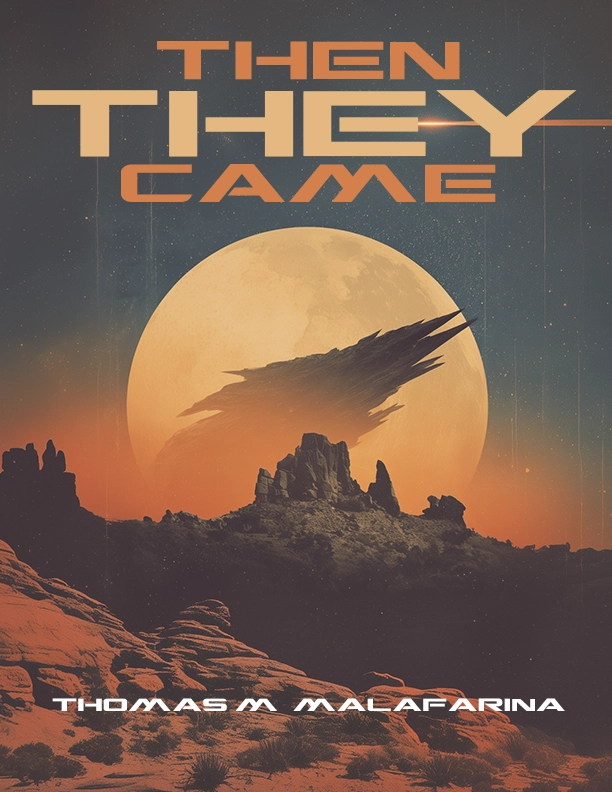
Then THEY Came
A Short Story Written by Thomas M. Malafarina1
The corn field had become yet another makeshift graveyard, but one for the unburied, rotting corpses of the thousands who had been slaughtered trying to flee to a safety that could never be found. The numerous bodies lay scattered, some atop one another, some alone, some intact, others broken with limbs missing, and some no more than bone and flesh fragments. The tattered, rotting remains of men, women, children, and various animals too numerous to count, all gathered together as if in some twisted artist’s landscape of the damned. Although the gut-wrenching stench was overpowering, the solitary survivor stood, staring intently, surveying the carnage. Somehow, he had become immune to the disgusting reek, or perhaps it was that he simply no longer cared. One might suppose that when you’ve walked daily in a world of liquified, rancid, decomposing flesh, the abnormal can become the new normal.
The buzzing of a billion insects was the nauseating musical accompaniment to this drama of death, this blasphemous ballet, this twisted tableau. These loathsome creatures landed on the rotting millions, feasting on their decomposition, while finding breeding grounds for their vile offspring. Worms, maggots, and the like continually bored holes into this human smorgasbord that had been provided for them in this once-productive agricultural paradise, turned rotting meat abattoir.
As he studied the carnage before him, the observer, Calvin Masterson, remembered how abundant the field had looked the previous year. The farmer, responsible for tending the land, had planted seeds in the spring, and by the Fall, the corn had grown to stalks towering over six feet high. The flourishing field had been a sight to behold, especially when combined with the vibrant multiple colors of the changing leaves. The scene would have created the perfect greeting card image of how Autumn in Pennsylvania looked. Wild deer could be seen making their way through the stalks, hoping to find an evening meal.
Then, when harvest time arrived, the fragrant smell of the rendered corn stalks combined with the dead and fallen leaves created a familiar scent that signaled to everyone accustomed to the changing seasons that Fall was almost over and Winter was just around the corner. These changes had been what Calvin had always thought of as the natural rhythm of the seasons, one that had unfailingly played year after year. But that rhythm would never be played again, as its beat had been silenced forever.
It was paramount that Calvin recall every nuance of that special “before time,” and that he treasure the memory of each smell, sight, and feeling because it was something he, or anyone else, still counted among the living, might never have the opportunity to experience again. That once productive field, now nothing more than a testament to slaughter, was free of all forms of non-insectile life, whether plant, animal, or human, and it reeked with the stench of the rotting dead.
This lone survivor, thirty-two-year-old Calvin James Masterson, looked out across the vast field, covered with a sight horrifying enough to bring the strongest men to their knees in prayer. However, Calvin wondered who it was that anyone had to pray to. If God were still out in the cosmos somewhere watching, he would probably be shaking his head in disgust. God had obviously abandoned mankind, not that Calvin could blame him. Although not an overly religious man himself, Calvin believed that humanity had long ago turned their back on God, in favor of a world dominated by obsession with money, greed, and technology. Perhaps that’s why the Almighty had chosen to allow this last assault, this final war, to take place.
Calvin was reminded of a time when he was a young boy. One of his chores was to clean up the mess in his backyard, the deposits courtesy of his pet beagle, Charlie. Armed with a bucket, lined with a grocery bag, and a shovel, little Calvin went to work. As he made his way around the yard, he found a dead, featherless baby bird. He didn’t want to leave the poor thing to rot or to become a meal for some backyard scavenger, so he scooped it up and dropped it in with the dog’s remnants.
It always bothered Calvin that the sad creature had ended up in such a degrading final resting place, and he felt maybe he should have taken the time to bury the little bird instead. But he decided what was done was done. Now, as he looked out across the field of corpses, he realized all those dead creatures in the field probably deserved a better final resting place as well, but in this case, too, what was done was done. They had seen to that.
However, the final conflict they had brought was not the conflagration mankind had feared for generations. It was not a war of nuclear devastation with one superpower raining lethal Hell upon another. Nor was it a war where biological pathogens reduced the world’s population to suffocating, bloody, rotting pulps. Ironically, the same force that destroyed essentially all of the world had, for a sadly brief time, united all the countries, former enemies and friends alike, in a futile attempt to defend themselves against this juggernaut of death. However, mankind thought they were prepared to protect the Earth, but they were not ready for the size and power of what was to come.
It had been late July of the previous year when NASA, the National Aeronautics and Space Administration, announced that they had found what they believed to be a comet leaving its place of origin in interstellar space, heading toward our solar system at an incredible speed. This comet was only the fourth known object from outside our solar system ever to be discovered.
It was coming from the direction of the constellation Sagittarius in the central region of our galaxy. At the time of the announcement, it was believed to be about 450 million miles from Earth. Scientists then predicted it would make its closest approach to the sun sometime in late October. They assured the people of the world that the comet posed no threat to Earth and that it would remain at least 170 million miles from our planet during its travels. NASA scientists said this newly recognized comet was the fastest ever discovered. They believed it was traveling at speeds in excess of 160,000 miles per hour and that its speed would increase as it got closer to the sun.
Astronomers categorized this object as interstellar because of the shape of its orbital path. They said it was moving too fast to be held by the sun’s gravity; therefore, its path was known as a hyperbolic trajectory. They assured the population that it would simply pass through our solar system and continue traveling back into interstellar space. Because of its speed and trajectory, it would never return once it passed Earth.
Scientists said they determined the comet to be at least seven miles long and were confident in categorizing it as a comet, not an asteroid. They assured that although the predicted trajectory of the object would bring it into our solar system, it wouldn’t come closer to Earth than about 170 million miles. However, despite all their analysis, calculations, and scientific speculations, they were wrong, and as it turned out, they were dead wrong.
A group of scientists started suggesting that the object might not be either a comet or a meteor. They said it might actually be a spacecraft because of the thing’s apparent shape and size. They claimed its speed and orbit were unlike anything we had ever seen. Some were so bold as to say that the chances of the object being natural were less than .004%. These scientists were ridiculed by their peers and made laughing stocks by the general public. Calvin doubted they ever lived to say, “I told you so.”
Likewise, Calvin never used social media, so he didn’t see the many posts about the alleged spacecraft. He also paid little attention to the news broadcasts in late September when the talking heads reported how the head of the Department of Defense was calling in all his generals from around the world for a special meeting in Washington. Had he done so, he might have wondered what was so important that it required pulling in all the generals. He and everyone else would soon find out what exactly that might be.
2
Calvin Masterson was no scientist, but a young man of above-average intelligence and a college graduate. His degree was in commercial art, a field in which it was challenging to find rewarding employment in the best of times. He appreciated that he had been fortunate enough to land a job right out of art school, working for an advertising firm in the city.
Initially, following the devastation, Calvin believed it wouldn’t have mattered what his choice of study had been in a world now as dead as this one was. However, as things turned out, Calvin’s choice of art as his field of education was exactly what was needed. He could use his artistic and observational skills to create a pictorial history of everything that had happened. He had no idea if there were any survivors other than himself, but he assumed there had to be people still alive somewhere. After all, Calvin had no previous survival skills, yet he was still among the living. Perhaps if others did survive, someday a future generation could learn from the sketches he provided.
Calvin had no idea what exactly had happened between the time the scientists said we had nothing to fear from the speeding comet and the disaster that followed. During that time, Calvin had paid little attention to the news reports, as like most people his age, he was busy working, dating, being young, and enjoying life. He had a nice apartment in the suburbs, outside his hometown, and felt he had more important things to do with his time than follow the progress of some giant ball of ice and gas flying through space. He vaguely recalled something about several similar, but larger comets heading in an analogous trajectory, each one estimated to pass safely by Earth a month or so apart over the span of several years. But he had paid that news no mind either.
Then one day in late October, very close to Halloween, while having drinks with friends at one of their favorite sports bars in the city, a special news report interrupted the game playing on five big screen TVs. Amid the moans and complaints of the customers, Calvin focused on the TV with great interest. It wasn’t that he was expecting bad news, but he could tell by the expression on the face of the reporter that something major was happening.
The reporter started to speak, struggling to maintain his professional composure, “We have just received this important word from the office of the President of the United States, that he has been in an important closed-door meeting with officials from NASA, the National Aeronautics and Space Administration, concerning the comet they have been following for the past several months.” Then the announcer swallowed hard, began to tremble and shake, lost control, and broke down sobbing and began shouting, “They were wrong! The scientists had it all wrong! It’s not a comet! It’s not an asteroid! It’s a massive spacecraft of incredible size. And it’s slowing down!” Several men came onto the screen and tried to pull the reporter off camera, as he screamed, “It’s an invasion! We’re all going to die!” Then the screen went black.
Calvin looked at his friends in disbelief, hoping to see one of them smiling, ready to assure him this was some sort of Halloween gag like Orson Welles’ historic “War of the Worlds” broadcast. Unfortunately, their looks told Calvin that this was no joke, but impossibly, it was the real thing. A second or two later, every electronic and electrical device in the bar went black. Calvin looked at his smartwatch and saw that it too was dead.
After that broadcast, Calvin soon learned that every television, radio, cellular, and computer resource in the city had gone dark. He assumed the same had happened throughout the state. At the time, he had no way of knowing it had simultaneously not only occurred throughout the US, but in every country in the world.
Calvin and his friends made their way out of the bar and onto the darkened street outside. They heard some people talking nearby, and one of them claimed that he knew about something called an electromagnetic pulse weapon, and a thing like that would have been required to turn the city’s electronics to toast. Only he said nothing that powerful existed anywhere on Earth yet. He said it would take something massive in size to fry everything electronic in the world, not just the United States. Then Calvin recalled the reporter screaming how the comet was a space vehicle of incredible proportions.
Looking up reflexively into the night sky, now clearly visible thanks to the sudden elimination of all light pollution, Calvin saw the full moon shining brightly in the star-filled sky. It was one of the clearest and most beautiful sights he had ever witnessed, reminding Calvin of how much technology and light contamination had spoiled man’s ability to see and enjoy the beauty of the night sky.
Then his breath caught in his chest as he saw an enormous, black shape slowly cross in front of the moon. It was so large that the moon and any previously visible stars disappeared from view until the dark mass passed. The thing had to be miles above the Earth, probably just inside its atmosphere, which meant it was impossibly large.
Calvin had never seen a sight like that and wasn’t sure what he was looking at. It was gargantuan, irregularly shaped, black, and completely silent. The craft appeared to be much larger than seven miles long. Even from its distance from Earth, it was obvious to Calvin that it was a massive spacecraft. Because of the thing’s incredible size, it appeared capable of transporting an entire civilization, a type of space ark. Then, as that realization became clear, Calvin saw several hundred panels slide open at the craft’s bottom. Each opening had to be several dozen feet across, backlit with a haunting green glow. Then thousands of saucer-shaped aircraft began descending out of the openings, looking like swarms of hornets leaving their nest, and the invasion began.
3
The Earth was unprepared for anything that followed, as nothing of that magnitude could have ever been anticipated. There was no time to scramble jets or launch nukes, as whatever weapon the invaders used had completely disabled everything at once, worldwide. Each of the hundreds of thousands of attack vessels that came from those eerie green panels had to have been given orders to destroy everyone and everything they encountered, which they did quickly and efficiently.
That night, after seeing the spacecrafts flooding from the mother ship, Calvin turned and ran for cover before the destruction began. Standing at the street-level entrance to a subway tunnel, he saw one of the massive saucer crafts land on the city park lawn. The area had been covered with several hundred spectators staring like tourists, looking curiously at the descending craft. Some were shouting and waving as if welcoming the visitors as new friends. Calvin couldn’t believe how stupid the people could be. Friendly visitors did not wipe out every defensive measure you had at your disposal, and then send down thousands of ships with the intention of having a picnic.
Calvin shouted to the crowd to run, but his voice was lost among the throng of cheering spectators. He saw all of his friends from the bar among the participants. As the ship continued its descent and the crowd finally came to their senses, it was too late. The huge craft touched down on the common area, crushing hundreds beneath it. In the distance, everywhere around the city, Calvin saw hundreds of saucer crafts descending.
As he stood watching the spectacle unfold, a panel on the colossal spacecraft slid open, and a glowing green light similar to the one Calvin had seen earlier on that mothership served as a backdrop for the horrid creatures he saw emerging from the radiant portal. He fought the immediate urge to run down into the subway as he used his artist’s eye to study the monstrosities rushing down the ramp, bent on raining death on everyone.
These creatures looked like some type of insectile species he had never seen before and were well over fifteen feet tall. At first, Calvin was reminded of those aliens known as Grays because of the creatures’ color, height, bulbous heads, and huge, oversized, segmented almond eyes, but that was where any similarities ended. They had other features similar to both the Xenomorph in the movie Alien and the space hunter in the movie Predator. But these attacking creatures were much more disturbing.
When viewed from the side, the monsters’ heads were elongated, ending in a bundle of long, serpentine tendrils that fell like dreadlocks down the creatures’ backs. To make matters worse, these snake-like appendages seemed to be in constant motion, each moving independently of the others. There appeared to be several dozen of these tendrils on each creature.
The aliens either wore some type of body armor or were equipped with a natural exoskeleton to protect them. Calvin couldn’t tell from his distance, but he suspected the latter as the armor seemed to fit too perfectly to have been anything but natural. The monsters had six long, muscular appendages running down their sides, which Calvin saw could be used as either legs or arms. Some of the creatures stood on two of their legs while the other four arms were available for fighting. Other creatures ran on all six legs at incredible speeds, then stood up on two legs when it was time to kill.
And kill, these monsters did. They carried no shields or mechanical weaponry such as guns or swords, but apparently, such things were useless to them. Calvin saw a man come out of a burning grocery store, armed with a double-barreled shotgun, shouting and swearing at one of the monsters, who towered over the man. The shotgun blasted, but the creature seemed unaffected by the attack. Then the insectile thing shot some glowing green liquid from its extremely long, almost humanoid fingers, and the man screamed as the acid melted his flesh from his bones.
It was both incredibly horrific and fascinating to see at the same time. Even though only a small amount of the green substance landed on the man’s hand, as he screamed in agony, the liquid began to rapidly multiply. Within seconds, the deadly substance covered the man’s entire body, dissolving his flesh and leaving a skeleton to collapse, rattling to the ground.
During that brief and futile skirmish, another man approached the creature from behind with a pistol and shot round after round at the beast. Calvin saw the bullets strike, then instantly dissolve. The monster didn’t seem to have any ill effects from the attack, but he saw his attacker. That was when Calvin saw another of the creature’s natural weapons that he had not seen previously. The monster had a long, curled scorpion-like tail with a razor-sharp multi-edged spine on the tip, piercing the attacker’s chest and dissolving him as it had done with the first. The cluster of long tentacles behind the alien’s head danced like Medusa’s serpents, spraying a similar green glowing substance on anyone within its range. Everyone who was hit, even with an amount as small as a drop, was dissolved screaming in seconds as the ghastly liquid multiplied.
That was when Calvin heard the first explosion and saw a nearby high-rise apartment collapse into rubble. The sky was full of those huge saucer-like spacecrafts, each firing some sort of invisible energy beam or pulse at everything in their path. Buildings, cars, trains, people, nothing could escape their onslaught. Everything that was hit exploded instantly. Building fragments of stone, brick, metal, and lumber flew everywhere, striking and killing every living thing in their path. Those in the direct path of the pulse were instantly vaporized. Others, at the fringe of the beam, were likewise killed, but their remains maintained some of their flesh.
Having seen more than enough, Calvin turned and ran down into the subway. He doubted he would be much safer underground than above, but he hoped that while the invaders were busy, he might get far enough away through the subway tunnels to survive a little longer.
4
In the blackness of the subway, lit only by faint moonlight coming in from the stairway and a few open craters made by the destruction above, Calvin worked his way down onto the track and headed in the direction he hoped would take him outside the city. He had no doubt the suburbs would not be much safer than the urban areas, but he hoped the invaders might initially focus on the cities. If so, he might have enough time to gather some supplies and find some place to hide until he could figure out what to do next, not that he believed such an ingenious revelation would ever occur to him.
As he walked with his hand on the concrete wall along the subway track to guide him through the blackness, he began immediately planning what supplies he would need. He would have to find some mode of transportation, like a bike, anything that didn’t require electricity or batteries. He also needed something to carry his supplies, maybe a basket, a backpack, or a wagon he could tie to a bike. Calvin realized he would need water. That would be more crucial than food, although canned and non-perishable food would be essential. He would need medical supplies, vitamins, sanitary bandages, facemasks, antibiotics, hand sanitizer, and the like. No doubt, with all the dead and discarded bodies, disease was destined to follow.
At the time, Calvin didn’t know if bugs and insects would survive, but he suspected, based on their sheer numbers, that they would not only survive but also flourish, thanks to the mountains of dead bodies that were bound to be available. He also knew there were no better spreaders of disease than insects. One untreated mosquito bite from the wrong bug would make him a dead man. In the back of his mind, Calvin couldn’t help but note that there was something insectile about the invaders. Was it possible the aliens felt a kinship with the insects on Earth, or was it simply that the bugs were too small and insignificant to matter to the invaders? Perhaps that was a thought for another day.
In addition to those important life-sustaining supplies, Calvin realized he had to find papers and pens. If he were going to try to document all he had seen, then it would be critical that he get those items as well.
Calvin understood he had to locate the most essential necessity of all; he had to find shelter, somewhere safe and secure, where the aliens would never look. He knew of a cave in the woods not far from his suburban apartment. Calvin had found it hiking one day, but never had the nerve to go inside. He was concerned that some wild animal might have made it his home. For all Calvin knew, that cave might only be a cutout, no more than a few feet deep. On the other hand, the thing might have gone a mile into the mountain.
He decided that if he ever got out of the subway tunnel alive, he would gather whatever supplies he could carry and immediately head for that cave. If it was a bust, so be it, but he had to find out. Then he realized he’d have to add a gun, knife, or weapon to his supply list. Although useless against the invaders, it could still protect him against wild Earth creatures of either the four or two-legged varieties. He had seen enough end-of-the-world sci-fi movies to assume the world had likely become a savage place of Darwinian survival, and Calvin knew he would have as much to fear from any survivors he might encounter as he did from the alien invaders.
As such, Calvin was watching for other survivors that might have taken refuge in the underground labyrinth of subway tunnels, but to his surprise, he never encountered anyone. After several hours of feeling his way in the darkness along the subway track, Calvin saw the light of a new morning coming in through an opening in the tunnel up ahead. Then he realized he had been wandering for many hours, as it had been dark when he entered the subway, and now he was seeing the light of day. That light gave him hope, and it took all his strength to keep from running out into the brightness after spending so much time in the dark. However, having seen first-hand what the aliens were capable of, Calvin was cautious and, as such, chose to carefully make his way out of the tunnel, watching the skies at all times.
Calvin was glad to see the skies clear of any airships and aliens. Despite the level of destruction, he could tell he was at one of the former suburban stations for the subway system. Everywhere he looked, he saw death and destruction. Every building for miles had been leveled, and the stench of death was overpowering. What was worse was that he wasn’t sure where he was in relation to where he needed to be. Keeping his ears alert and eyes vigilant to any movement, Calvin went through the rubble to what he hoped had been a street.

With debris piled high on both sides and a narrow five-foot strip of blacktop, Calvin determined he must be on a street. Looking out into the distance, he saw that the street eventually became a highway. The further from the city Calvin walked, the more highway and less debris he found. He suspected this was the main roadway into the city and had been, like in most places, lined with strip malls and fast food joints. The amount of debris from one of those places was substantially less than that from multi-level and high-rise buildings in the city.
He noticed he didn’t see any cars, trucks, or vehicles of any sort. Then he saw pieces of twisted metal of all different sizes and colors. Some were large, while others were barely the size of a small piece of notebook paper. Calvin also saw hundreds of metal parts; if he used his imagination, he might recognize them as former engine or transmission components.
He continued to watch the skies for any invading ships but saw none. He supposed this was to be expected. If the purpose of the attack was death and destruction, then, except for Calvin, there was obviously no other killing to be done here. This place was the definition of death, as there was nothing alive here or for as far as the eye could see. Calvin was tired, hungry, and thirsty, but he had no choice but to walk on. As he did, he looked to the sides of the road, hoping to find something from the rubble. After an hour or so, just when Calvin had given up hope of finding anything, his eye caught the sun reflecting off something a few feet within a debris pile.
Calvin walked over, and to his surprise, he saw a broken metal sign still partially intact. It read “Big John’s Groc.” That was where the sign was cut off. However, that was fine with Calvin, because it told him two things. First, this rubble pile was from the former Big John’s Grocery store. That meant there might be supplies he could use buried under this mess. The other thing it told him was that he was only a block or two from his apartment.
As Calvin looked in the direction of where his building should be, he corrected himself and thought, “the place where his apartment used to be.” Every building had been leveled in this area as well. He was surprised to see that periodically along the roadway, there were clusters of tall trees. Calvin had no idea why the aliens had not destroyed some of the trees while destroying everything else.
He was momentarily caught off guard by a flood of emotions. Not only was this the place where he lived, but it was also only a mile from where he grew up. His childhood home was somewhere out there, relegated to a pile of rubble. All of the places of his childhood memories in the suburban town had been destroyed. Had Calvin’s parents not died together in a car accident several years earlier, they would most certainly be dead now. He had to assume that all of his friends and relatives were now dead as well. Calvin was alone, but felt he owed it to the dead that he should survive and carry on.
Out here, far from the city, Calvin started seeing what he recognized as a few cars in various stages of destruction. Some were flattened like a giant had crushed them beneath his feet, some were upside down and wrecked. He saw a few skeletons hanging out the windows, their partially flesh-covered bones rotting in the stagnant morning air. He walked over to the side of the road, and in a tree-shaded culvert, he saw a large tractor-trailer on its side. Calvin made a mental note of the location so he could check it out when he had time, assuming he lived that long. He had other, more pressing matters to attend to for the immediate future.
Then Calvin remembered something else: a bicycle sales and repair shop was directly across the street from Big John’s grocery store. If luck was with him, he might not only find some supplies, but perhaps he might also find a bike or at least enough components to build one. First things first. Calvin lifted the large metal grocery store sign and flipped it over out of the way. He couldn’t believe his luck. Lying on the ground was a canvas backpack. If he found food or water, that backpack would certainly come in handy.
Calvin reached down and pulled on the backpack. It seemed to be caught on something. He gave it another tug, and he heard a cracking sound. It was one he unfortunately recognized. As the pack broke free, Calvin saw bones and dust flying through the air as the skeleton of the pack’s former owner crumbled to pieces. He didn’t understand how the clothing and flesh of the backpack’s owner had been dissolved to nothing, yet the backpack remained intact. Perhaps that was a question for another day. For now, Calvin had a backpack and could look for supplies.
Then, noticing the backpack had some weight to it, Calvin opened the main flap and was astonished to find the thing stuffed full with bottles of water, cans of soda and soup, and various packaged snacks. Calvin thought he had died and gone to Heaven, which was interesting, since the entire landscape around him was a living Hell.
5
He immediately opened and drank one of the bottles of water. Even though it was warm, bordering on hot, it tasted incredible. Next, he found a beef stick and a bag of pretzels and made short work of them as well. For a brief moment, Calvin questioned his actions, not knowing if the items he just ingested were safe or not, but he opted to push that worry aside. He had somehow survived an alien attack that wiped out everyone around him. The world was essentially a graveyard. He previously had no food or water, which meant he was on the verge of either dying of thirst or starving to death. So, if the things in the backpack were tainted, then so be it. If he lived, he lived; if not, he’d die. Calvin would take his chances. As things turned out, his luck was still holding up, and the food was fine.
Calvin continued to dig in the rubble and was thrilled to find more food and water than he could hope to carry. Then he remembered the bike shop across the street. He crossed over and saw what must have been the front door of the place lying on the ground, its former glass window shattered in a million pieces. Calvin figured that since he had had good fortune by flipping the sign at the grocery store, he might also get lucky here. He lifted the door out of the way, and to his surprise and pleasure, Calvin saw a set of concrete stairs leading down into a cellar.
As he reached the bottom of the stairs, Calvin was reminded that one of the most important things he needed to find was a flashlight. The cellar was pitch black, save for the little light from the stairway. Calvin heard wood creaking and realized the floor above him, acting like a roof, was precarious at best and more likely untrustworthy. He decided the only thing for him to do was take a quick look around to the best of his ability, then get out of there before the floor collapsed on his head.
Calvin saw something red shining in the limited light and recognized it as a bike reflector. He walked over, pulled the thing into the light, and couldn’t believe his luck. It was an adult-sized three-wheeled trike with a small basket on the front and a huge basket attached like a trailer on the back with its own wheels. Not wasting any time, Calvin dragged the heavy trike and trailer combination up the stairs and out into the light. Although such a chore under normal circumstances might prove challenging, in Calvin’s weakened condition, it took a Herculean effort to accomplish.
Examining the bike further, Calvin saw the tires were all in good shape. He wasn’t certain, but he believed they might be what people called “hard tires.” That meant they were designed for durability and puncture resistance. Those would be essential for where Calvin was going. As he wheeled the bike to where he stacked his supplies, Calvin felt the earth shake and feared the aliens had returned. He looked up into the sky in terror, but saw no signs of the invaders. Then the floor over the bike shop collapsed, and tons of rubble crashed into the cellar. Had he stayed there a minute longer, Calvin would have been buried under that debris. Although he wouldn’t have been alive very long.
As he loaded the bike baskets with the supplies he could find, Calvin realized with amazement how lucky he had been. For someone with virtually no survival skills, he had somehow managed to make it this far. He was not arrogant enough to even think of claiming one ounce of credit for his survival. If he ever needed proof that such a thing as luck existed, he had just gotten it.
Calvin climbed on the bike and headed up the rubble-strewn road toward the distant forested mountains. It was where he recalled seeing the cave several summers earlier. If his luck continued to hold up, the cave would not only be empty but large enough for him to use as a shelter. As Calvin passed where his small apartment building once stood, he stopped for a moment to examine what little remained of his home. It hadn’t been a large place, just one bedroom, with a small bathroom with a tub but no shower. But it had been his first place and he had loved living there.
As he looked out at the rubble that had been his previous life, Calvin saw the corner of something he recognized sticking out of a pile of debris. It was his leather art portfolio. It contained many sketches and paintings he had done in the past, but more importantly, it also contained several blank sketchbooks. He hoped that if he could unearth the portfolio, he might also find his paints, pens, pencils, and brushes that he kept nearby. Calvin made a beeline for the leather satchel and began clearing the assorted wood, plaster, and brick fragments off so he could retrieve it. The aliens had so thoroughly destroyed everything with their weapons that wood, stone, and brick had been pulverized into small, manageable pieces.
As he lifted out his portfolio, Calvin saw what he had hoped he might find underneath. It was several low plastic storage containers where he kept his art supplies. Calvin realized how ridiculous people might think he was to be so happy to find pens, pencils, brushes, paints, and such when the world around him was dead, and he had no idea where he might find food and water after his meager food supplies ran out. But Calvin had already made it his responsibility to make a picture-based historical account of what had happened. So far, the universe had chosen to take care of him, and if it meant for him to complete his task, it would continue to do so.
6
The trip through the woods to the cave proved to be quite challenging. Initially, Calvin was surprised to find the forest intact. He had assumed the aliens would have destroyed it along with everything else. Perhaps their focus was primarily on buildings and people. Maybe they were unsure what to do with the forests and had chosen to leave them alone for now. Calvin doubted that it would last very long. He believed that as soon as the invaders detected people running into wooded areas to hide, they would also start systematically destroying them. But for now, he thought he was ok.
As Calvin had recalled, there was a dirt path through the woods, mostly as wide as the distance between the wheels on the trike and basket, but in places it was a bit narrower, and Calvin had to deal with that. The trail was also abundant with exposed tree roots and large rocks, which were other obstacles Calvin had to negotiate around. The result was lots of stopping, starting, getting off the bike, adjusting, and getting back on. Eventually, he made it to the outside of the cave.
Calvin decided that before he took the time and expended the energy to unload his cargo, he had better first investigate the cave to determine if it was usable. The best thing about the cave was that the entrance was hidden not only by thick brush but also by the hill itself. Rather than being a visible front-facing opening, the entrance was behind a large section of the hillside, requiring access from the side. This provided a natural, hidden camouflage, preventing any passerby from discovering it. Had he not been a curious kid, Calvin never would have found it so many years earlier. He wished he had had the courage back then to have investigated the cave, but he hadn’t.
He looked around for anything he might use as a weapon. He realized he was once again lucky that he hadn’t encountered anyone on his way through the woods. Had he met up with some hostile individuals bent on doing him harm, he would have been in trouble. Calvin found a heavy, pointed stone in the bushes and grabbed it tightly with his right hand. It would do him little good against a wild animal, but might help with any troublesome humans.
The one thing he wished he had that he felt was almost as important as a weapon was a flashlight. He knew his smartphone had a light, but that device was toast. Now that he thought about it, Calvin wondered if something like a battery-powered flashlight would still work. Would batteries also have been toasted by the aliens’ weapon? Calvin didn’t know, but if he were a gambling man, and he was, he’d be willing to bet the world’s batteries were as useless as the devices they once powered. How was he going to get light into that cave? Then Calvin had an idea.
He remembered when he was a kid, one of his buddies was given a magnifying glass for his birthday. He let Calvin and the other boys take turns starting fires by directing the sun’s light through the magnifying glass onto dry leaves. One of his sicko friends, Billy, used it to burn ants alive. For a brief instant, Calvin wondered what had ever happened to twisted little Billy. Then he realized chances were, Billy grew up, got a job, and got wiped out by alien invaders like almost everyone else.
But at least recalling junior psycho Billy and the magnifying glass of death gave Calvin an idea. He looked up, and although it was a bright day, the sun wasn’t clearly visible through the haze of dust particles that covered the skies, the result of the destruction. But maybe if he could find some clear glass to act as a magnifier, it still might work.
Calvin began to empty the remaining contents of the backpack he had found, and was disappointed to find that all the bottles of water and soda were plastic. Then, at the bottom of the backpack, he saw the remnants of what had once been a clear drinking glass. It had apparently broken at some point; fortunately, the pieces were large. Being careful not to cut himself, Calvin withdrew one of the largest pieces of glass. Then he tore a sheet out of his sketch book containing a drawing he wasn’t fond of and scrunched it into a ball. Next, he added some dry leaves and did his best to focus the sunlight through the glass piece.
It seemed to take forever, and several times during the process, Calvin stopped to take breaks. Finally, using branches, he built a small structure over the pile of leaves and paper, allowing him to suspend the glass over the material without having to hold it himself. He had recalled reading once how a brush fire had started by someone discarding a broken bottle in the woods. If that were true, then his idea should eventually work.
While he waited patiently for the fire to start, Calvin found several hefty sticks and wrapped the ends with some cloth remnants he had found along the way so that he might have a torch to use in the cave. He didn’t want his outdoor fire to be very big, as attracting the attention of any aliens was the last thing he wanted to do. But if he could keep the fire small, yet sufficient enough to light his torch, he might be able to check out the cave.
Eventually, the dried leaves began to smoke, then smoulder until they burst into flames. Not wanting to waste a second of his precious daylight, Calvin brought his makeshift torch to the fire, and soon it was set ablaze. Immediately, making his way through the cave entrance, Calvin held his torch out before him to light his way. As Calvin entered the cave, he first realized that the place had a nice-sized area inside the entrance. For a moment, he became concerned that some explosive gas might be in the cave. However, he was already standing inside the cave, holding a lighted torch, so he supposed it was too late to worry about such things.
The cave appeared to be about fifteen feet deep and perhaps twenty feet across. The ceiling sloped upward from about seven to ten feet. Calvin looked to see if there was any tunnel leading deeper into the earth, but found none. Then he looked for traces of any prior animal habitation and likewise found none. He wedged the torch into a crack in the wall and quickly went outside to make another, which he brought into the cave and secured on the opposite end. These two crude torches would have to do until he could devise a better way to light the cave.
Calvin began unloading his supplies into the cave until his bike basket was empty. Then he looked up to where he believed the sun was hidden behind the smog and decided that with the several hours of daylight remaining, he would return to the streets below and look for anything he might find in the rubble that he could use.
The first thing Calvin did was check the overturned tractor-trailer lying on its side in the washed-out gully. He remembered to bring a few tools with him in case he encountered any obstacles. The path down the slope to the trailer was steep and treacherous. Calvin was careful as he descended, being sure not to sprain or God forbid, break his ankle. He was certain that such a misfortune might be a death sentence for him. He made it safely to the bottom. Looking skyward, Calvin saw that the trees in the gully were tall and formed a canopy over the trail.
Calvin walked over to the cab and saw the dead, but intact body of its driver sticking halfway out of the broken windshield. Calvin hoped the man’s death had been quick and painless. Had the man crashed his truck, fleeing for his life, or had an explosion from a spacecraft caused his vehicle to flip over into the deep, shaded gully? Calvin would likely never know the answer to that question, but one thing he planned to find out was what was inside the trailer. Was it food, water, medical supplies, or possibly weapons?
Walking to the rear of the trailer, Calvin saw that the double doors were closed and secured with a padlock and a chain, which had been fed through two door handles. Although the chain was heavy-duty, the padlock wasn’t. It only took a few strategically placed strikes with his hammer to open the lock. Calvin pulled the chain from the door handles and grabbed one of them. Since the trailer was lying on its left side, Calvin chose to pull the left door open. When he did several cases of spring water tumbled out onto the ground. Although Calvin was grateful for the water, he hoped he might find other items he could use. He was not disappointed. The truck must have been on its way to some superstore when the aliens attacked because it contained almost every essential item Calvin might need.
In addition to the plastic water bottles, Calvin found more canned soups, vegetables, and fruits. Calvin also saw several dozen large decorative candles, each about 3 inches in diameter and 5 inches tall. They would burn for quite some time. He also found a box with several dozen cigarette lighters, most of which were in good condition. No more relying on primitive methods for starting a fire, at least for a while. He had also found many other objects that might be considered trivial under normal circumstances, but nothing could be taken for granted in Calvin’s brave new world.
Calvin couldn’t believe his luck. He realized what he had in this trailer was essentially his own private superstore that he could access whenever he wanted. It might not have had everything he needed, but it had plenty of useful items. One of the things Calvin found that he wasn’t sure what to do with was several stainless steel bathroom mirrors. They must have been intended for whatever store this truck was heading to. Calvin put them in the basket to take back to the cave, but wasn’t sure why he had taken them.
On returning to the cave, Calvin recalled something he had learned in grade school. It was how ancient civilizations who lived in caves used highly polished reflective stones to direct sunlight into their underground dwellings. Maybe that subconscious memory told him to bring back the mirrors. Whatever the case, Calvin found many other things along his way back, including another hammer and several other assorted tools.
Calvin returned to his cave an hour or so before sunset. He stuck his head apprehensively into the opening and saw that his torches had burned out. Lighting one of the candles with his cigarette lighter, Calvin looked back inside the cave, happy to see it still unoccupied by either animal or human. He placed the candle on the ground a few feet inside the cave entrance. He was surprised by how much light was generated from the single candle. He returned and unloaded the remainder of his treasures, including the stainless steel mirrors. He pushed the trike deep into the bushes, where it was invisible to anyone on the ground or anything in the air.
Once back inside the cave, Calvin stood the mirrors around the room. Some were worn and scratched, but they seemed to work just fine. There were six of them, and as he predicted, they did a great job of spreading the light around the cave. Calvin was pleased with how well things were progressing. On one hand, he felt proud to have accomplished so much with no prior survival experience. On the other hand, he chastised himself for taking too much credit since, in reality, he had the detritus of an entire ruined world at his fingertips. All he had to do was look and find whatever he needed, assuming the aliens didn’t discover and eliminate him.
As night fell and the last of the sunlight faded, Calvin sat on the ground, under the smog-filled sky, trying fruitlessly to locate the moon or stars. He recalled how, on the night the aliens attacked, he could look up into the heavens and see thousands and thousands of beautiful stars just after the power went off. He remembered how he had been awestruck until he saw the moon blacked out by that incredible craft he thought of as the mother ship. While he sat staring through the haze, desperately looking to find even a single star, Calvin felt a strange sensation, like a vibration in the pit of his stomach. Then, behind the smog, backlit by the moon and stars, Calvin saw the silhouette of one of the enormous saucerships passing overhead.
Somewhere back in Calvin’s mind, he had hoped the aliens might have moved on. He assumed the aliens’ mission would have been completed once the Earth’s population, buildings, and infrastructure were destroyed. Yet the shadow of that spacecraft remained above. Why were they still here? Why hadn’t they gone yet? What was their long-range plan for Earth?
Calvin saw the shadow of the saucer ship heading to the west side of the forest. Suddenly, he recalled that there was a lake over in that direction. Doing his best to remain hidden under the trees, Calvin followed the ship, determined to find out what it was planning. As he came upon a clearing, overlooking the lake, Calvin got onto his stomach and crawled forward to see whatever he could.
To his shock and astonishment, the saucer craft was hovering over the lake. A long, thick tube resembling something insectile traveled from the craft to the lake. The thing was sucking water from the lake into the craft. As if this were not bad enough, Calvin saw several dozen other saucer crafts approach and drop similar hoses into the lake. As Calvin watched helplessly, the water level on the lake quickly began to fall. He thought, “Oh my God! They’re draining the lake, stealing all the water.”
7
As quietly as possible, Calvin turned and hurried back to the cave, looking behind him and keeping his eye on the skies the entire time. Once safely back inside the cave, Calvin lay on his back on the dirt floor, staring at the ceiling, contemplating everything he had witnessed. The creatures had neutralized every electronic device and weapon available. He had seen the strange aliens slaughter thousands of people without compassion. He had to assume they had killed millions, if not billions more, around the world. They had destroyed every building they came upon. The aliens did not attempt any form of communication with anyone on Earth. It was like neither humanity nor animals had any meaning to them other than something to be destroyed. Calvin wondered why.
Then he had witnessed the alien ships draining the fresh water from the lake. He wondered if they were only interested in fresh water or if they would also take salt water. If so, then they would likely be draining the oceans, too. But could they do such a thing? Calvin didn’t think so. They might be able to put a major dent in the water supply, but Calvin believed draining an entire planet’s oceans was something beyond the invasion force’s capability, despite its incredible size.
Then he recalled something else he had heard on the news, something he had forgotten. Scientists had said something about several dozen, if not more, larger comets heading in a similar trajectory as the first, each one estimated to pass safely by Earth a month or so apart over the span of several years.
With this last thought, Calvin suddenly realized he had answered his own earlier question. He now knew why the aliens had decimated almost every living thing on the planet. It was the same reason that when a construction company cleared land to build a housing development, they uprooted trees where birds live, crushed ant hills that millions of ants called home, destroyed burrows where underground animals resided, thoughtlessly killing dozens in the process. It is simply because these insignificant creatures, we, were in the way.
These aliens wanted our water and saw Earth’s creatures as nothing more than ants or insects; they knew humanity would try to stand in the way of their goal. So, like the bulldozer plowing through shrubs, trees, and ground with total disregard for any creatures living there, these aliens saw humans as insignificant pests that needed to be eliminated to get what they came here for.
This first craft had been sent to wipe out the population. That ship would likely remain in orbit and continue to hunt humans in preparation for the arrival of each subsequent craft. Then Calvin understood. These first wave aliens were taking the fresh water to drink while they continued their mission. Likely, each subsequent larger craft would begin draining the oceans, then return to their home planet and perhaps supplement their depleted oceans. Then the ship would likely return to Earth for more. If the scientists’ predictions were accurate, a new spaceship would arrive every month for as many years as it took to drain the Earth dry.
In the meantime, the saucercrafts would patrol the Earth seeking out and destroying any living creatures they encountered. Eventually, Earth would be a barren, waterless rock, incapable of sustaining any life, including Calvin’s. It was over. Calvin realized that now. He decided the best he could do was to document everything that had happened in words and pictures, then place the book inside the cave. Perhaps some future life form a million years from now might stumble upon it and learn what had happened. That’s what Calvin did. When his work was finished, he wrapped his book in plastic, tucked it into a crack in the cave wall, then walked down from the mountain, through the trees, and stood transfixed before the former cornfield, now turned graveyard for thousands. As he looked out over the horrid mass of broken and rotting corpses, Calvin felt a vibration in his stomach, looked up, and saw one of the saucer crafts hovering in the sky above him. He smiled, looked up at the craft, and gave the middle finger salute as his one last act of defiance. He never felt the force beam that obliterated him and merged his flesh and bones with the thousands of others in the field of death.
Story Tags
alien encounter Cosmic horror disturbing imagery dystopian eerie atmosphere existential dread extraterrestrial life horror fiction survivalDate Modified: 12-13-2025