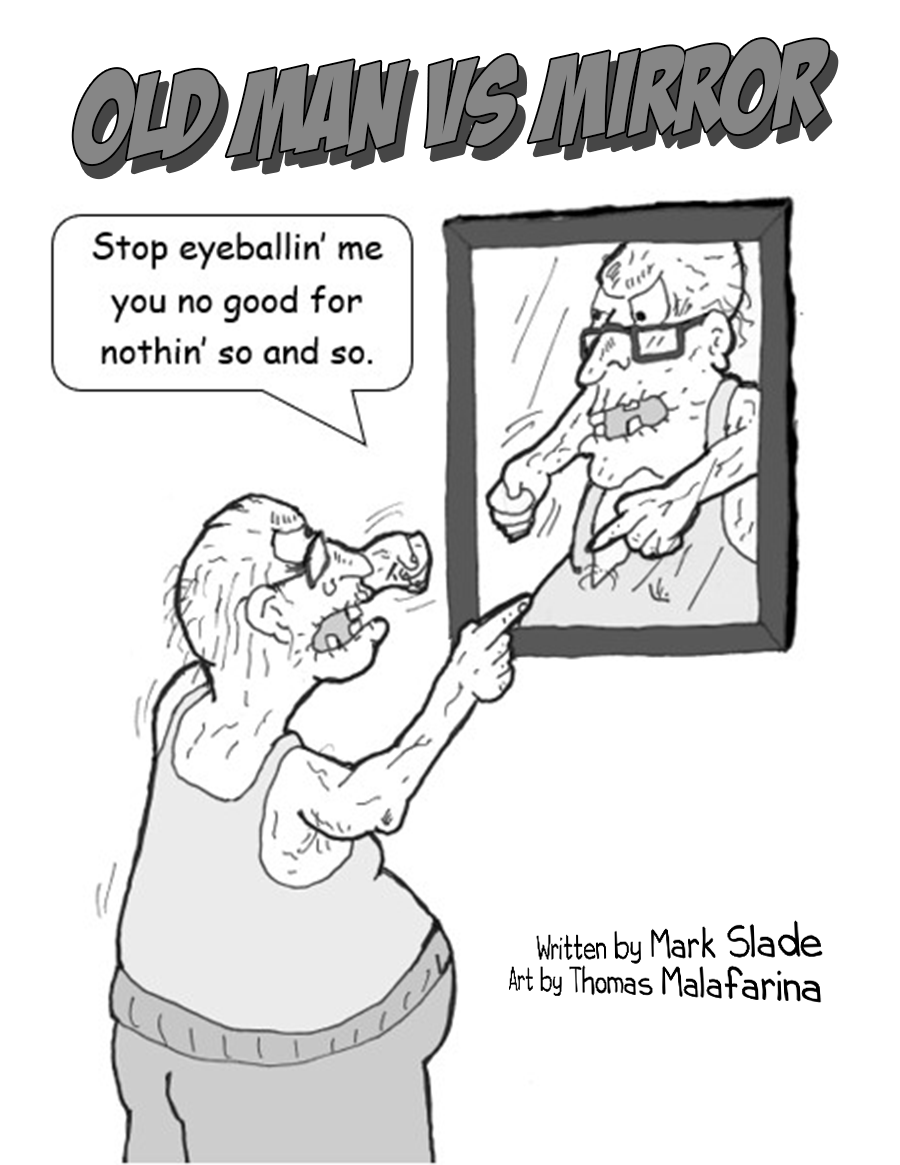
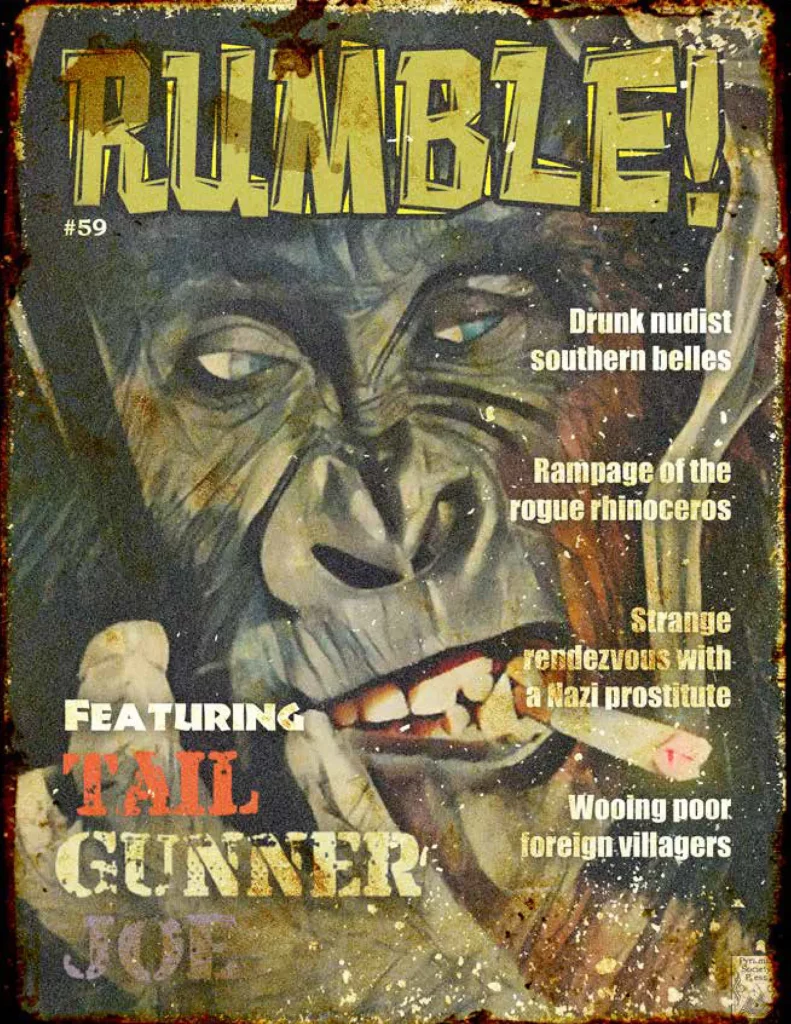
Issue 41 of Twisted Pulp Magazine has crash-landed, and hoo-boy, did it bring some carry-on! This month’s mag kicks things off with a hellish tale from E.S. Wynn (“On the Devil’s Dole”—because punching a clock for Satan pays better than working retail), then barrels headlong into twisted fiction, retro rants, and deep dives into the weird and wonderful. We’ve got an interview and art from cover artist Dan Henderson, a philosophical brawl in Old Man vs Mirror, and the long-awaited scholarly vindication of Grease 2 by Scarlett Stratten—because it is the word. Mark Slade drops two—count ‘em, TWO—bombs with Lodger 42 and a review of Van Halen at 50, while Susan Elizabeth Gray makes sure your feels aren’t safe with Silent Legacy. There’s noir creeping in with Brian Warf’s A Dead Ringer for a Black Fox, plus the underground godfather Gilbert Shelton graces us with an interview and some truly excellent art. We wrap it all up with a spotlight on The Russell Theatre’s Shane Farmer and a Malafarina classic, Tail Gunner Joe. It’s hot, weird, loud, and probably a little stupid—so basically, it’s just another issue of Twisted Pulp. Dig in.
I need to create more. I don’t need to be prolific. I assume that at my age, and in my situation, the ship of prolifery has sailed. But still, I need to create more. By “create” I mean do something myself. This magazine doesn’t count because it is a shared endeavor, but perhaps it should.Continue reading "Editorial: Am I Still a Creator If I Rarely Create?"
I need to create more. I don’t need to be prolific. I assume that at my age, and in my situation, the ship of prolifery has sailed. But still, I need to create more.
By “create” I mean do something myself. This magazine doesn’t count because it is a shared endeavor, but perhaps it should. This editorial doesn’t count because it is a bimonthly obligation, but again, maybe it should count.
At this point I feel that I create about one thing a year, maybe two. Set this against the amount of time I think about creating and it’s embarrassing.
Does that mean that I’m a poser? Do I just dream of being a creator? Am I a creator who does not create?
What amount of creating do I have to do to consider myself a creator? Think of a painter. How many paintings must they paint a year to claim the title? Maybe twelve? Twelve paintings a year, and you can reap the rewards of feeling accomplished by referring to yourself as a painter. Seems fair.
Maybe it’s money. Does one need to make money to truly feel that they are a creator?
Are you a writer? Did you write twelve stories last year? If so, did you make any money? When is the point that you can refer to yourself as a writer, even in your own head?
My dad would have you believe that my mother did this to me— that she entitled me to the point where I could believe I could be anything. Things like “You can be a paleontologist someday, you just have to want it and to believe”. Maybe she wasn’t quite that saccharine, but you get the point.
I think my mom’s overindulgence and my dad’s criticisms gave me a case of “analysis paralysis”, a fear of too many choices.
No, I don’t mean that I have this clinically— more so that people in general, specifically Americans like me; we have analysis paralysis as a lifestyle. Not as a driven fear but as a learned behavior from our upbringings and lifestyles.
Even now I am doing it— running lyrical circles instead of doing anything of purpose for myself.
So, time to lock the door, dream some horror, and write some lore because my procrastinating ass needs to create more.
Date Created: 09-15-2025
Date Modified: 09-15-2025
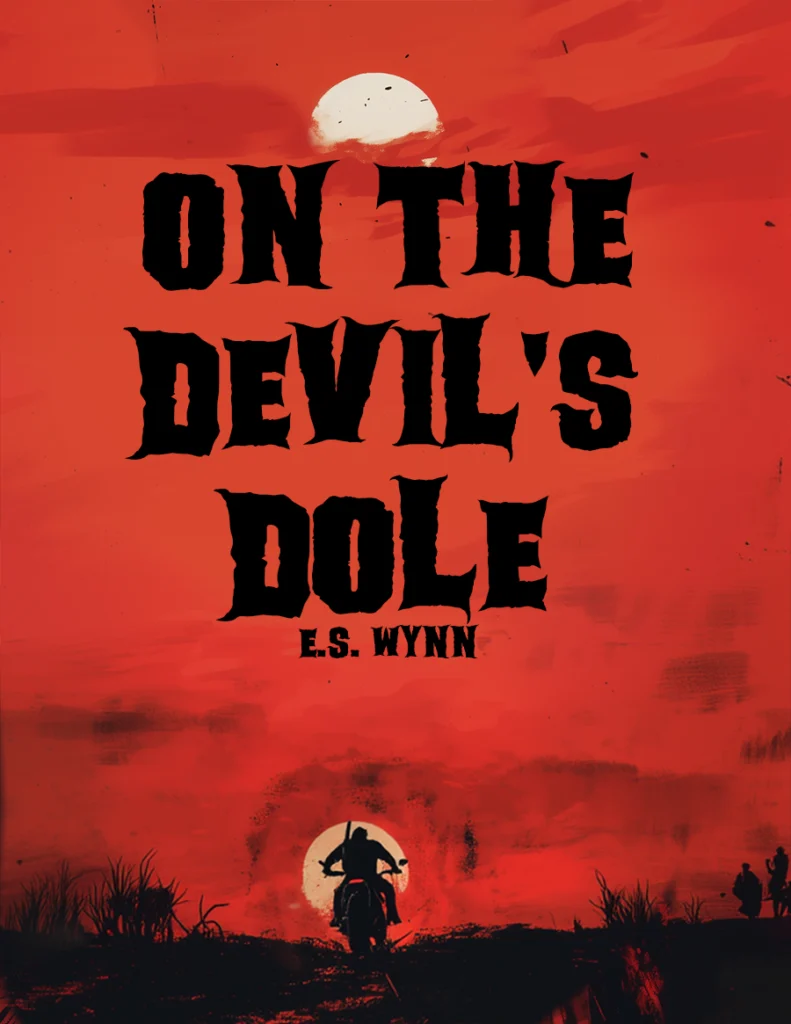
Each week, another address, another sinner. The Devil’s payroll comes with perks, but also with a curse.
If I ride hard and I ride through the night, I’ll reach Barstow by morning.
And there,
There, I’m gonna kill me a man.
Don’t know the guy. Never met him. Never had any hatred for him neither. All I have is his first name, an address, a list of things I’m supposed to say when I kill him.
Every week it’s the same thing. One name, one address, one list of things I forget as soon as I’ve read it to the poor sucker on the wrong end of my twelve gauge. Sometimes the name is someone just a few miles down the road, sometimes halfway across the country. Sometimes the name I get belongs to a girl, sometimes to a little kid, but most of them, most of the names I get are men, mid-thirties or forties, balding, in business or accounting, a job that puts their dirty hands in contact with a lot of easy money.
All of them have one thing in common.
All of them are sick.
The big man downstairs isn’t the type to volunteer details, and most things I remember when he does speak mean about as much to me as someone else’s roadkill. Way I understand it, there’s a storm coming, a real hellfire and brimstone storm that’s long overdue, and the plague that’s been leaking out of hell for the past six months is just the leading edge of that storm. The plague– it isn’t a physical sickness, isn’t caused by a virus or some mutated, weaponized strain of bacteria cooked up by men in a lab. It’s something else, something altogether different, something terrifying, demonic.
The last man I killed was Roger Harrison, 5012 Silverbirch Lane. The list was long, ten or twelve things I was supposed to remind Roger of before I killed him. Hardly got as far as sticking the barrel of my shotgun through the crack of the door before he turned, eyes bulging, stretching blood-shot and yellow. They all do that when they turn, but not usually until after they wait and beg, act scared, act repentant, realize I’m not there just to remind them of all the terrible things they’ve done in their lives. It’s the terrible things that make them ripe for the infection, or so I’ve been told. All the things they did to others that caught the eyes of the horrors festering and breeding inside of them, spreading, fighting for control of meat so sweet with sins. I guess word’s been getting around in hell about me, because they’ve started begging less and fighting more. I don’t expect my next target to go down easy. Hell, I almost hope he doesn’t. Been a long time since one of the horrors were smart or sly enough to get loose of hell and Old Scratch gave me a decent fight.
Never gets boring, the killing. Neither does the riding, the long, empty road between names. Never thought the Devil would have me hunting his horrors for him, but doing his dirty work keeps me on his dole, keeps me floating in burgers and booze, in gas and parts for my growling hog, keeps shells in my gun and brings the easy pussy that makes the whole ride worth while. Best work a guy like me could ever hope to get, especially considering the fact that I’m sick too. More than sick.
The hell-plague claimed me years ago.
It’s just too bad it doesn’t kill you when it takes you, only changes you into a steadily rotting slab of moving meat, strands your damned soul somewhere between life and death, somewhere the chorus of demonic voices can scratch out your senses and torture you with waking nightmares that make you wish for the mercy of a man like me.
A man with a shotgun who knows the horrors festering through you. A man with a shotgun sanctified to put you out of your misery, send you screaming to the hell you’ve built for yourself with a life full of spite, selfishness and sin.
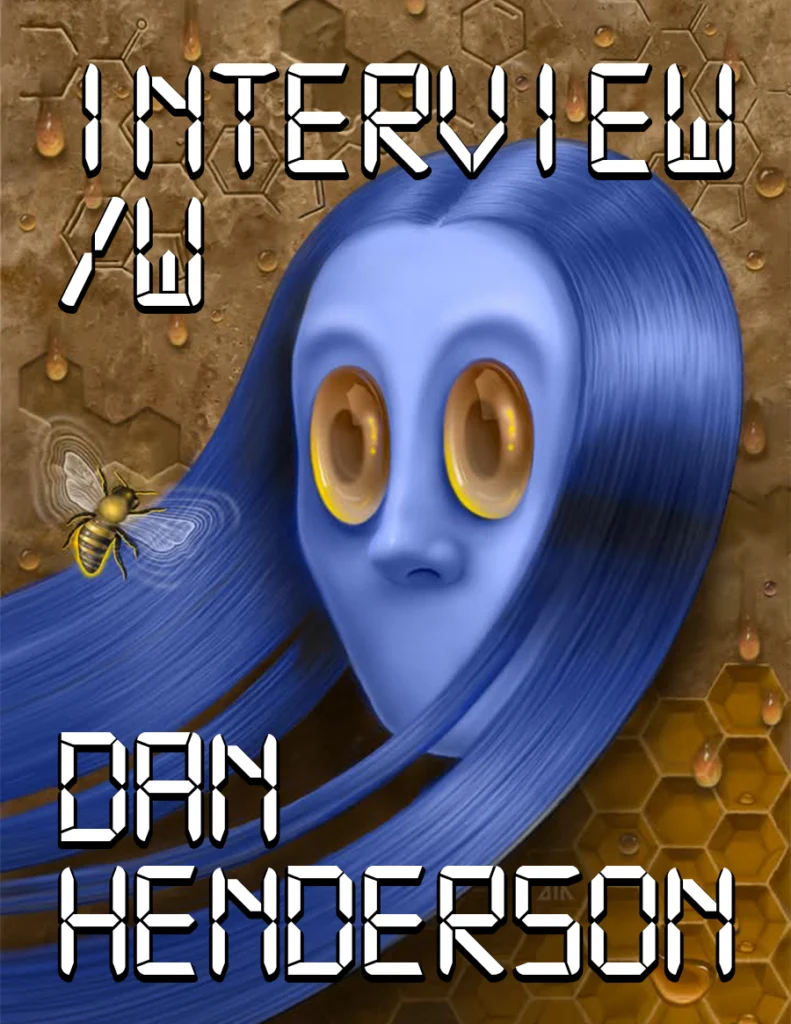
Dan Henderson’s art lives in the space between pulp nostalgia and personal mythology, where charcoal, colored pencil, and digital ink bring vivid, often whimsical visions to life. A former professor with a rich academic background in art and design, Henderson has spent decades refining a unique visual language.
Where are you from? What is your background?
I’m originally from Atlanta. I received a Bachelor of Fine Arts from The Atlanta College of Art and a Master of Fine Arts from Georgia State University. I was a design and art history professor for many years, including a stint in the U.K. at The American College in London.
What inspired you to become an artist?
I’ve been drawing from the get-go, which is ironic since I was born with a congenital eye condition (strabismus or “crossed eyes”). That condition causes the brain to choose one eye to be dominant. I had several childhood surgeries that failed to correct the problem. It rendered me essentially monocular, with zero depth perception. I’ve often wondered if that had anything to do with my ability to draw. I always wanted to somehow draw professionally, but an opportunity presented itself and I ended up in a teaching career. Happily, my drawing activity had high relevance in the classroom.
You have a unique style. Why did you start doing pinup drawings?
My “style” just seems to be my innate visual language. English is my primary verbal language and whatever-the-hell these drawings represent, my visual language. It flows when I draw.
What performer or artist/writer inspires you the most?
As for inspirations, they are diverse. Even though I have an extensive education in art history, the most profound inspirations came from things like early Mad magazine and monster movies. Whatever you see at an early age sticks, regardless of further education. Artists like Wallace Wood and Jack Davis had a big impact. Frazetta’s work for Creepy magazine was fantastic. The cover art Kelly Freas did for Mad in the late ’50s was profound. Interestingly, I never tried to copy the style of the artists who inspired me. Instead, I tried to find the core of the energy they evoked in their work. I tried to tap into what was under the surface. Attempting to find exactly what excited me about their work made me explore and discover my own path. Luckily, I had an older brother who used to bring home those magazines when I was too young to buy them myself. He was also an avid reader and kept me loaded up with classic science fiction novels from a very early age. I’ve also been greatly influenced by cinema. There are many directors I could name, but Alfred Hitchcock is near the top of my list. He embodied the entire history of film, all the way back to the silent movie days. His formative experience with silent film made him rely on the purely visual, and that emphasis can be seen in all of his subsequent work. I guess I would have to add Stanley Kubrick to the list, for similar reasons. Most of the present-day directors I enjoy seem to have been influenced by those two.
What other areas of art are you involved in?
Another creative outlet for me is film. I minored in photography in college and did many experiments with video. I’ve been doing short films for a number of years. These are mostly for my own amusement and sharing with friends. When I’m not drawing, I’m working with Final Cut Pro.
Do you think your environment, where you live, has an effect on the type of art you create?
I don’t think my physical environment has had a particular impact on my work. The only time I felt impacted in that way was when I was living in England. There’s so much history there, and I did some work that drew upon that experience.
What long-term goals do you have?
My only long-term goal is to keep drawing. I spent many years drawing with graphite, colored pencil, pastel, and charcoal. My graduate work consisted of large-format paintings. A couple of years ago I bought a digital tablet. I took to it right away. I can work faster and chew through ideas at an accelerated rate. My approach is the same, just more efficient time-wise. That is an improvement, having once spent a solid year on a colored pencil drawing (!).
What do you think popular culture will be like in ten years?
It’s hard to predict pop culture trends. They tend to be somewhat cyclic. There was a time when rock & roll reinvented itself every ten years. We seem to be overdue for that, or maybe those days are gone. I can only imagine that artificial intelligence will have a huge impact. How we react to that change will form popular culture.
What’s the strangest thing you’ve been asked to do in your profession?
The strangest thing? Hmmm. I’ve done lots of freelance stuff. For a while I was doing patent drafting. These were very precise ink drawings of various inventions and machine parts. Ink is not my favorite medium; I remember holding my breath as I drew precise ink lines. You couldn’t make mistakes. It had to be perfect. One invention involved a video game console. Actually, it was for an arcade game. The proposed game had a Van de Graaff generator built in. That’s one of those gizmos that makes your hair stand up (if you have longish hair). The gimmick was that when achieving a certain score, the juice would kick in and your hair would go wild. A Polaroid-type camera was situated in front of the player, and you would get a photo of your wild hair event. I had to depict this event with linear ink work. The funny thing was: the other patent artists who worked for the law firm were really good at things like machine parts, but they freaked when it came to drawing people. I always found drawing cartoons to be pretty natural, so for me that was the easy part. I got a bonus for drawing “the easy part”!
What projects are you working on now?
Currently I have 5 or 6 drawings underway. I try to always have several ideas brewing. My last published piece was in a book called Imaginary Universes (Citadelles & Mazenod, 2023). It’s a history of literary science fiction with an image for each story covered. They used one of my drawings to illustrate The Invisible Man by H.G. Wells. It’s a big, beautiful book, but it’s all in French, and as I said earlier, English is my language so I just look at the pictures. LOL
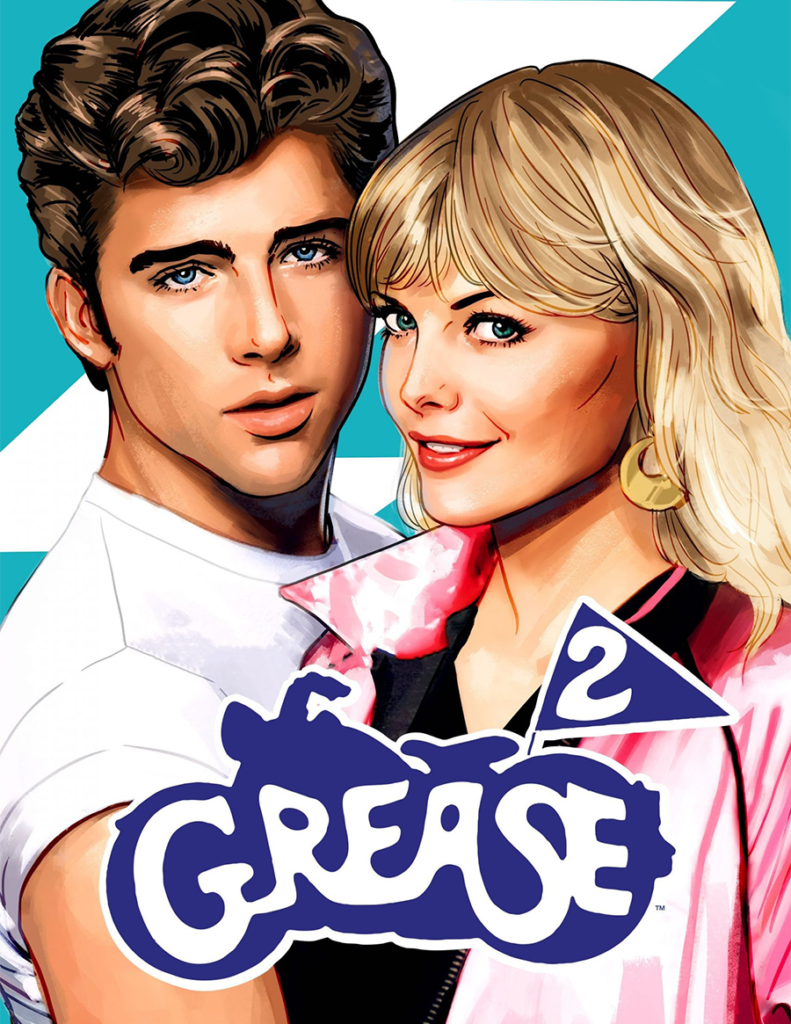
A forgotten sequel with great songs, surprising chemistry, and a cult soundtrack worth collecting
Written by Scarlett Stratten
Beneath the shadow of a blockbuster and unfair critical scorn lies a sequel bursting with charm, chemistry, and surprisingly catchy songs. This personal reflection dusts off the vinyl and gives Grease 2 the second chance it always deserved.
I was recently asked what the wackiest record I own is. I had to think about that, because “wacky” has not been the motivation behind my vinyl purchases. Frankly, outside of “cool old shit”, I don’t know what the driving force behind my collection is. But in my hunting, I have managed to pick up a few albums that could feasibly fall into the “wacky” category.
Chief among them would probably be the Grease 2 soundtrack.
Listen to the Grease 2 Soundtrack
Firstly, yes this is real. I am not making it up, it’s not a parody, it was a theatrical release that came out in 1982 and stars a young Michelle Pfeiffer, English actor Maxwell Caulfield, and even Judy Garland’s daughter Lorna Luft. The story centers around Michael (Caulfield), the British cousin of the first film’s Sandy, and his quest to win the heart of Pink Lady Stephanie (Pfeiffer). He does this by learning to ride a motorcycle and disguising himself as the mysterious “Cool Rider”. Shenanigans and songs ensue and eventually everyone lives happily ever after at the big graduation luau.
And that’s pretty much it.
Watch Grease 2
In case you hadn’t guessed, this film failed to live up to the hype of the original from 1978. It received dismal reviews from critics who saw it as a lesser retread of the first one, and while it did make a small profit, taking in $15.2 million against a budget of $11.2 million, it opened the same weekend as ET: The Extra-Terrestrial. That all but guaranteed it was going to sink. And drowning right alongside it were the careers of several of its actors, most notably Maxwell Caulfield. He had been hailed as the next big thing, but once Grease 2 was released, as he put it, “nobody would touch me”. The only things that saved Pfeiffer from a similar fate were a combination of the positive notices she received for her performance and her casting in Scarface the following year.
With all that being said, it’s really not that bad. I mean it’s not a masterpiece, and there are plenty of clunky moments and blatant attempts to cash in on what people liked about the first one. But it certainly isn’t bad enough to warrant the reputation it garnered at the time. As crazy as it may sound, there are things I actually like better in this movie versus the first. For starters, the chemistry between the two leads is better. Danny and Sandy were great, but I never really bought that they were actually in love. Michael and Stephanie though? I fully believe they are crazy for each other and that the motorcycle wasn’t the only thing that got ridden after graduation. I also find the time period easier to believe. Cars and poodle skirts notwithstanding Grease reeks of the 70s in every frame. But Grease 2? It’s the 60s, Kennedy is in the White House, and I will hear no arguments.
Most importantly, I like the music better. I know this is subjective and everyone is entitled to their opinion, but for my money, the songs in this movie SLAP. Where the numbers from the original film, while classic, never fully escape feeling like pieces from a musical, almost all the songs in the sequel listen like radio hits and get stuck in your brain accordingly. My particular favorite is “Cool Rider”, sung by Pfeiffer giving major 80s rock diva energy. And while cheesy, “(Love Will) Turn Back The Hands of Time” is a solid romantic ballad. Honestly, most of the singing is great throughout, and while Maxwell Caulfield isn’t quite up to the level of the rest of the actors, he’s enjoyable enough and it’s clear he’s trying. His overall performance is enough to make me sad that his career stalled after the film because he truly deserved better (shout out to Netflix for putting his silver fox ass in The Merry Gentleman; highly recommend).
This all brings me to my vinyl copy of the soundtrack. When I stumbled across it I was at a local record store that specializes in having a little bit of everything; used, new, whatever you might be looking for. I was pawing through their bins of discounted vinyl when I found it. As soon as I saw that cover, Maxwell’s pouty lips and smouldering eyes staring back at me, I knew I needed it. Because it was in a box with other recently received inventory, it didn’t have a price tag, so I took it up to the counter to inquire how much it would be, trying my level best not to skip the whole way. The guy took it from me and slipped it from the cover to look at the record itself. He examined it and informed me that because it was slightly damaged, they would just give it to me for free.
Needless to say that was a banner day in my collecting life.
Luckily for me, while the record does skip a bit on certain songs, overall it works enough to be enjoyed and I am thrilled to have it in my collection. If I’m being honest, even if it didn’t work at all I would still treasure it. In all of my previous record store searches, I have never seen another copy of this soundtrack anywhere. By and large, this seems like a forgotten movie, so I count myself lucky to have found this album at all, let alone in as good of condition as I did. Happily, it seems that there is a slow but steady reevaluation of the film coming about and I hope this trend continues. Whether it was a victim of its own hype or simply couldn’t step out of the shadow of its predecessor, Grease 2 is one of those gems that truly deserves another look. It has fun songs, likeable performances, and its own flavor that make it something special. In short, it and its soundtrack both deserve another ride.
Date Created: 09-08-2025
Date Modified: 09-08-2025
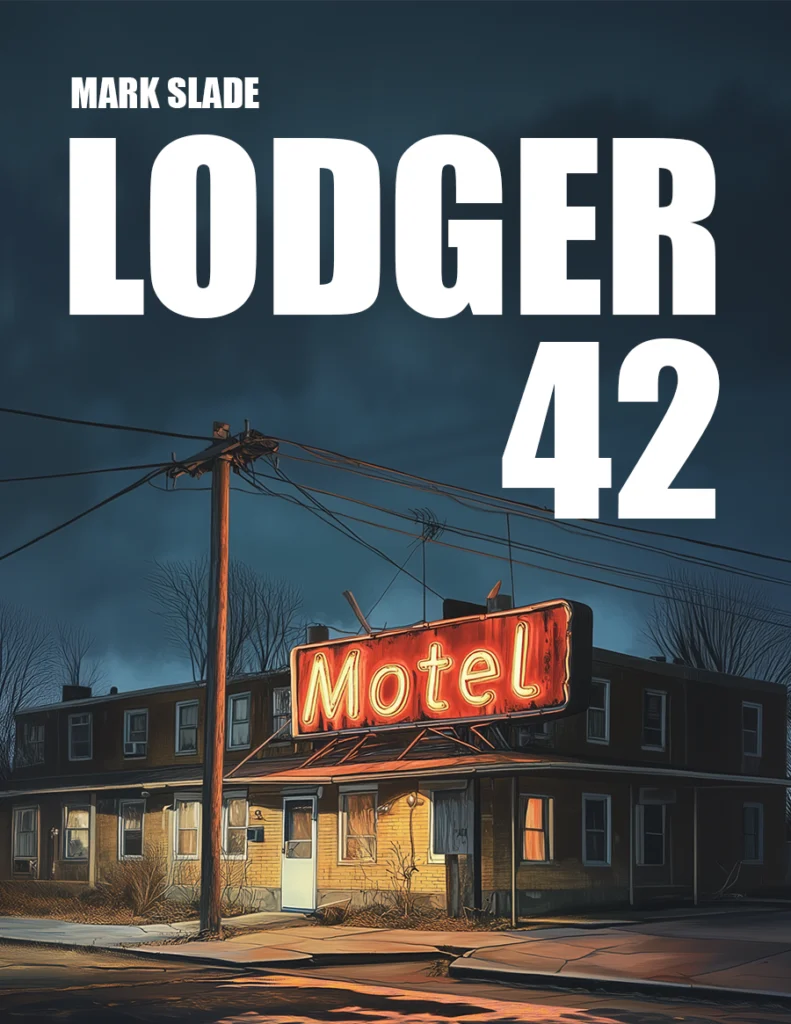
Fugitive Ira Biggs is running out of options. Holed up in a grimy motel with his accomplice Helen, paranoia grips him—until an unexpected visitor arrives with an unbelievable offer.
Ira was on the run and held up in a small, rundown fleabag hotel outside of Baltimore. Room number 42, ground floor, with a view of an alley with two dumpsters full of trash, and an old homeless woman beating a rat to death with a rolling pin. She gave out a victory cry, placing the bloody animal into her rusty shopping cart, then moved on behind an empty warehouse.
Ira shook his head.
“Disgusting people in a disgusting city,” he said. “How the hell did I get to this low point in my life?”
He choked back tears.
This is how he got here.
He had traveled halfway across the country from San Diego with Helen, hoping the cops wouldn’t catch them, but if they did, they would go easy on her. She was only helping him because she’d fallen in love, and you can’t prosecute for that, can you?
“I shouldn’t have stolen that money,” Ira said. He was staring out the window, taking long drags from his cigarette, staring at two little boys in the street trying to dribble a flat basketball and not having much luck with it. He could relate. “Yep. That’s what their lives are going to be like. Nothing but disappointments. One big, fucking flat ball. That’s what your world is going to be,” he tossed the cigarette at the window, the lit end struck the glass pane and caused a minor combustion as it fell to the floor. He put his face in his hands and screamed, “Why did I take that stupid money?”
A half a million, that’s why, he thought.
The door swung open and Ira swallowed his heart. Panic stricken, he let out a fierce squeal. It was only Helen with two paper bags in her arms.
“Why didn’t you open the door for me?” She rushed to a small, crickety table in the middle of the room. She slammed the bags on the tabletop, cans and bottles clinked.
“Oh, God,” Ira caught his breath. “I thought you were the cops coming through the door.”
“I called out to you!”
“I didn’t hear you.”
“You never do,” Helen unloaded canned goods and bread from one bag and started on the second containing a dozen eggs, a package of bologna, and a bottle of whiskey. “You don’t hear anyone but yourself, Ira Biggs.”
“Don’t call me that,” Ira adjusted his thick framed glasses on his pale, skinny face. “My mother used to call me by my whole name. My teachers, my old bosses—so, just don’t. Okay?”
Helen turned to him quickly. She studied his miserable face. She was still angry, but felt a wave of sympathy for him. Or was it pity? Is that the right definition of what she feels for Ira?
It must be. He occupies her mind more than anything else. When Helen looks at him, she sees hurt in his expression and she just wants to hold him.
“Alright, Ira,” she said softly. “I won’t.”
Ira shook his head, watched the young boys kick the flat basketball back and forth. The ball had no bounce left, it barely rolled between the boys’ dirty Puma knockoffs.
“I wish I hadn’t stolen that money,” Ira said.
“Hey,” she went to him. Hesitantly, she gently stroked his cheek. “What’s done is done. Don’t fret. Everything will work out.”
Ira pushed her hand away. “Easy for you to say, You’re Not the one who is going to jail.”
“That’s not exactly true,” Helen said. “I was your secretary. I knew what you were up to. I helped you hide the money in offshore bank accounts, I helped you escape. I’m up to it to my neck, Ira, and I’m sick of it.”
Ira shrugged. “So walk.” He went back to staring at the boys playing with the flat basketball.
“I can’t,” Helen sat at the table. “I’m stuck. Stuck in the rat trap I set for myself.”
Advertisement
Rapid fire knocking alerted Ira and Helen, taking them out of their misery. They glanced at each other, then the door. Ira began to hyperventilate. Helen stood, then froze. She didn’t know what to do.
“You can let me in,” the deep, gravelly voice said from behind the door. “I’m not a cop.”
“Well, who are you?” Helen asked.
“No,” Ira demanded. “Don’t answer.”
“Please Ira,” Helen said. “I’m tired of running.”
“Then turn yourself in, Helen! I don’t care! I’ve got enough on my mind to think about you.”
“Mr. Biggs, I assure you, I am not with the Police. As a matter of fact, I am here to help you avoid capture.”
“Why would you do that?” Ira thought a second, his eyes darting back and forth, eyebrows jotting up and down. “How do you know I’m even Ira Biggs?”
“Mr. Biggs,” the gravelly voice said. “If I were the Police wouldn’t I have already smashed the door in and arrested you both by now?”
Silence.
Helen said, “He’s right, Ira. Cops don’t ask permission.”
Ira walked to the door, removed the chain, unlocked the door knob, and opened it partially. He saw a decrepit, elderly old man in a wrinkled black overcoat and black homburg too small for his peanut-shaped head.
“You can let me in, Mr. Biggs,” the old man said. “I won’t harm you.”
“How do I know that?” Ira said.
The old man laughed. He showed Ira his cane. He opened his wrinkled overcoat. “I’m not armed, Mr. Biggs. You’ll have to trust me,” the old man pointed his cane at Helen. “Besides, your companion already trusts me. You might as well at least pretend to do so.”
A pause. Ira swung the door open, and gestured for the old man to come inside the small room. Crossing the threshold, Ira noticed the old man’s limp, and a missing left shoe squared at the foot.
“Much obliged,” the old man tipped his beat-up homburg. “Do you mind if I sit? These old legs aren’t what they used to be.”
“Why no,” Helen stood, offering the chair to the old man.
“Just get on with it,” Ira said abruptly.
Helen went to him, patted his shoulder. “He will,” she said soothingly. Ira brushed her off.
The old man smiled. He sat in the chair in one go. He almost fell on the tabletop.
Reaching into the inside pocket of his overcoat, he produced a coin the size of a bottletop. He held the coin between his thumb and forefinger. Raised it up in the air for Ira’s benefit.
“Right here is a coin that will buy you your freedom, Mr. Biggs.” The old man turned it over twice with his fingers. “British Half Crown. Minted in with the year of our Lord, 1886. As you can see, a portrait of the Queen Mum, Victoria dons this coin.”
Ira leaned forward, squinted at the weather-beaten coin. He made a face. “That old junk? What are you trying to pull? I have news for you, buddy, we’re in America, and that coin can’t buy a Snickers bar here.”
“Well,” the old man chuckled. “Technically it can, and more than likely several houses—”
Advertisement
“I can’t use it,” Ira interrupted.
“Let him explain, Ira,” Helen said.
“Shut up, Helen. This old geezer is a fraud. I don’t know how you know about me, how you found me, but I bet you have turned us in—”
“How I found you? I didn’t. The coin found you.”
Ira laughed. “He’s a damn nut.”
“Oh, sure. I am a little crazy. You would be, too, if you went through what I have been through. You question what reality is.” The old man paused. “What I am is not a fraud, Mr. Biggs,” the old man said. “But I am a murderer.”
Helen gasped. She clutched Ira’s arm tightly.
“No reason to be afraid of me, Madame. I do not wish you or Mr. Biggs harm. I did wish my wife harm. Plenty of it.” The old man grit his teeth. “I hated her and her awful laugh, her awful walk, her annoying voice. That’s why I killed her.”
“Why are you telling us this?” Ira’s voice quivered.
“Being honest.”
“You don’t have to be with us,” Ira said. “I don’t care. I just want to know why you’re bothering us.”
“This is a part of the deal,” the old man said. “I found someone to take my place. Lord knows I’m beat. Beaten down. Beaten to a pulp.”
“Don’t talk in riddles,” Ira raised his voice.
“Please dear,” Helen took Ira’s hand in hers. “Let him explain. Patience.”
“I’m all out of patience, Helen. God hates me. He always has.”
The old man chuckled.
“I agree,” he said. He tossed the coin on the table. It bounced toward Ira, but never left the tabletop. “This is your only salvation. Unless you want prison.”
“I don’t want to go to prison.”
“I don’t either,” Helen said.
“Take the coin, take my place. I don’t care which of you does it,” the old man tried to smile, but it came out as a grimace.
“Take your place for what?” Helen asked.
“Sister, all you need to know will be explained when one of you touches that coin. Once a hand or finger touches it, you’ll know what I know.”
Helen and Ira exchanged worried glances.
Ira shook his head.
“Uh-uh,” he said. “You’re a scam artist. Fat chance I’ll pick up that coin or anything—”
Advertisement
The coin began to form a red glow around the edges and table lit up like a nightlight. Ira and Helen’s eyes grew bigger. Helen gulped, tried to speak when footsteps echoed in the hallway.
Voices were in the hallway. Ira swallowed hard. Panic crossed his face. Helen clutched his arm, dug her nails into his elbow. The voice drew closer as did footsteps upon creaky floorboards. Both passed the room’s door. A man and woman of the night promising sexual delights.
Helen and Ira breathed easy. The old man cackled.
“See,” he said. “I’m promising you relief from that.” He pointed to the door. “Out there, my friends, they will be hunting you. Forever, if need be.”
“What if they never find us, eh?” Ira said. “What if they forget about us?”
“They won’t,” the old man said. “And be sure somebody, somewhere, will recognize you.”
“I’m scared, Ira!” Helen squealed.
“Shut up, will ya!” Ira screamed.
“No, Ira,” Helen moved away from him. Ira followed. “You might be able to live with the fear of people coming after us, but I can’t live with the fear.”
“You don’t have to!” Ira came closer to her. Helen took a step away, inches from the wall. “You can leave anytime you want!”
“I don’t care what you say, Ira! I’m going to take the coin to save us!”
Helen reached for the coin. Just as fast, Ira grabbed Helen by the neck with both hands. He squeezed more and more. Helen screamed; gagged, panted, begged, then went limp. Ira let go. Helen’s lifeless body fell to the floor.
Ira glared, and Helen’s wife, dead eyes glared back.
“What have I done?”
“You’ve just done something a desperate man would do,” the old man said. “You’re better off without her. Blah!” The old man turned his nose up and shook his head. “She was much too clingy for my taste.”
“I-I never meant to hurt Helen,” Ira said, still in shock.
“Sure you did! C’mon fella, don’t aggravate yourself over piddly stuff! Move on. Now to the real business at hand.”
The old man offered the half crown to Ira.
“Real business?” Ira asked.
“Take it,” the old man grit his teeth. “Take it, or I’ll alert the authorities of what you’ve done.”
Ira took a breath. He glared at the coin between the old man’s fingers.
“It’s the death penalty,” the old man said. “Or the coin. It’s your choice.”
Ira took the coin.
There was Ira, dressed in black from top hat to boot; scarf covering his face; on the streets of White Chapel, London England—1886—on the hunt again, for more blood of another woman to appease the coin.
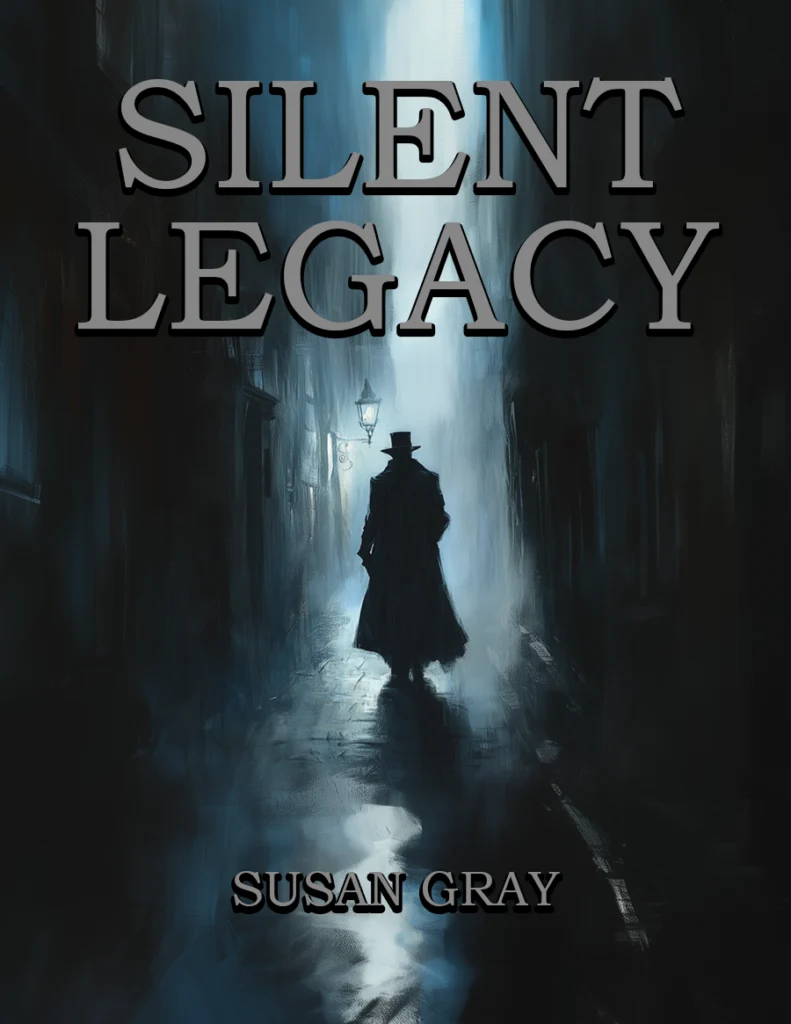
In the blood-soaked streets of Whitechapel, 1888, a nameless street urchin witnesses a shadowy figure at work—a killer whose knife moves with the precision of an artist’s brush.
You will never know my real name, though I came to know his. He taught me that, among other lessons that have held me in good stead these many years, in many cities, and across several continents.
In good faith I must tell you that I was not raised a gentleman, nor was I educated in the traditional sense until I reached the age of ten. The only childhood memories I have are of the streets of Whitechapel and Spitalfields, sleeping on piles of rags in whatever doorway or stable yard I could find, fighting with the rats for food scraps outside eateries, and running errands for the doxies to earn a half-penny or two to buy a bun.
You may wonder, Dear Reader, how a penniless street urchin became educated, quite literate, in fact, and in favorable circumstances here in these United States. That part of the tale will be found later in my missive, and you shall hear it, with patience.
Back to my life on the streets. It was the devil’s luck alone that led me to Buck’s Row in late August of the year of our Lord One thousand Eight Hundred and Eighty-eight, scarcely an hour past midnight. In search of an empty doorway, I came upon a man in a great dark coat that billowed at the sides, a soft felt hat on his head, pressing a shabbily dressed woman up against the brick wall. I made to skirt over to the other side of the Row, when I heard a sharp cry, not the usual sort made in the nightly street couplings of Whitechapel, then silence. I turned to look and saw a flash of silver in the pool of light from the gas streetlamp, a glint of a thin blade as the man thrust it into his companion.
I froze, afraid at first to move and be discovered, but then became mesmerized by the grace of the man’s movements. It was like a dance, how he moved his arm and wielded the blade, dipping and rising as it cut through first the woman’s clothing and then her skin. A smell of copper filled my nose, along with another oily scent, as he pulled long gray-purple ropes from the woman’s body and draped them across her shoulders.
Something stirred in me then, came alive, deep within that I had no foreknowledge of existence. It was as if I had swallowed a worm, or one of the weevils ever present in the crusts of bread I ate had taken root in my gut and filled my body with its larva. I felt a nameless energy, and desire.
He carved no more than five minutes, ten at the most, and it was beautiful. Finished, he wiped the blade clean on a scrap of the woman’s clothing. He turned to look at me then, the hat pulled low on his forehead. His dark eyes pinned me in place, as he raised an eyebrow and pointed the blade of the knife at the collapsed woman, then back at me.
“Are you afraid, boy?” he said.
I shook my head, not trusting my voice.
“Good,” he said, and put his fingers to his lips.
I nodded, and knew he understood that I would heed his direction and not say a word of what had transpired. I watched, motionless as he walked down the alley, then came to my senses and began to run after him, to follow, but by the time I had come to the corner, he was gone.
All through the following week, I searched for him, especially in the hours after midnight. I stayed in Buck’s Row several nights, but then realized he would not come back to the same place. So, I went further afield, several blocks in each direction. Once I thought I had found him, sure I had recognized him by his hat and brown great coat, only to be given a gruff slap and told to be gone or I’d receive a beating. I had almost given up hope when nary the next day, I espied him near Hanbury Street, close to dawn, about to step out of a stable way. I pressed myself flat against a doorway, then began to follow. I’d hardly gotten two blocks when he stopped suddenly, turning swiftly around to catch me by the wrist.
“Are you following me boy?” he said in a low growl, lips barely moving under his heavy moustache.
“I mean you no harm, sir,” I managed to say.
“You got a good look at my work last week, did you not?” he said, his eyes narrowing.
“Yes, sir,” I managed to say.
“And did you like what you saw?” he said.
“I did sir,” I said, and he released my wrist, and took a step back.
“Well then,” he said, folding his arms across his chest. “You are an unusual boy. A boy I might have a use for.”
From that day on, we were a team. Oh, not a team of equals to be sure, but I deluded my young self into thinking so. He took me back to his room in a half-way decent boarding house on the outskirts of the West End. He let me sleep on a pallet on the floor and gave me coin to buy food.
During the day, I was alone, content to rest above the street and have a full belly. But I accompanied him on nightly journeys, serving as look out for anyone who might be passing by, and pointing out likely corners on which the doxies would ply their trade. My appearance was the same, at his insistence as my ragged and odiferous clothes allowed me to blend in and be free from notice.
I proved my worth a little more than a fortnight from our first meeting. We were in Dutfield’s Yard, an hour past midnight, and he was just about to get started. He’d lured the doxy in quite easily, and just as easily drew his knife across her throat. I was near the gate, eyes on the street. I heard footsteps, and the scraping of a constable’s baton against the brick walls, the sound of which I had long been familiar. I gave the signal, and he dropped that night’s quarry to the ground, and we quickly made our way through the back gate.
But fortune smiled on us a half an hour later, as we came upon a deserted corner near Mitre Square. This time, he brought me closer, and though I kept watch, I was able to sneak glances as he worked, and hear him as he described what he was doing.
“Begin with a long incision starting just under the collar bones, then slash the sides. Pull the flesh back, and remove the intestines out, gently. You don’t want them to break or get pierced by the knife; the odor is insufferable. And you must be certain to take the uterus out completely. That’s where they carry their spawn, my boy.”
It took no more than minutes until he said, “And finally, the face. It’s what draws us in, and the invitation in the eyes.”
Advertisement
I watched as he slashed through each eyelid, and made deep cuts on each cheek. He wiped the blade on her dress, then we were off.
The next morning, I came back to the room with a bag of fresh baked Chelsea buns and several newspapers at his request. We sat, sipping watery tea, as he read.
“These rags have got it all wrong, my boy,” he said, wiping crumbs from his moustache. “They think I’m a monster, but how is ridding the world of these Salomes, these Magdalens, these harlots, an evil? I hone my skills and do a public service at the same time.”
He gestured toward the papers once more and scoffed. “They print these letters, as if I would pen such dross with spelling errors and nicknames. No such ignoramus could do what I’ve done and leave the police with nary a clue.”
“Mark my words, boy,” he said. “They will never know me.”
Afterward, we made a game out of it, each day he read the papers to me, and we watched the police chase their own tails trying to catch him. It made me laugh, listening to their theories and speculations, knowing how far they were from the truth of the matter at hand.
We kept busy through the month of October, though none of his work was discovered by the police, or the jackals of the press. He relied on my knowledge of the streets, and, to our mutual delight, knowledge of where the dung heaps were, the offal scraps tossed, and chamber pots emptied. A body taken there, dug into the bottom of the pile, would decay politely, its odor masked by the reeking refuse above.
And then came the last. Number 13 Miller’s Court in Whitechapel, the ninth of November.
This one had her own lodgings, and there was no need for me to be look out.
“We’ll take our time,” he said. “I’ll show you how it should be done.”
And show me he did, with that sharp blade. Oh, it was a sight to be seen, even to this very day!
I watched, fascinated as he pulled out her entrails, sliced her off breasts and removed her uterus. He worked swiftly, careful to keep any viscera or blood from splattering his clothes, though it veritably covered the walls. He showed me how to hold the knife, just so, the tip entering barely an inch – all that was needed to flay the skin from her abdomen and thighs. And how to sever the veins and muscles holding her heart in place.
When he was done, he looked me in the eye and gestured for us to sit down, he perched on the only clean corner of the bed and me in a wooden chair. He told me this would be the last, that he was returning to America as his studies were complete. I was bereft, thinking only of my return to the streets, the hunger not the worst of it but the loneliness, as this man had become the father, brother, friend I had never had.
“Not to worry, my boy,” he said. “I have found a situation for you. As I once told you, you are a most unusual boy. I believe you have a talent, a talent that could be developed over time with the right training.”
“There is a surgeon I know, one who believes me to be a colleague from a university in the United States. We have formed a bond, and I asked him if he would be willing to take you in, that you show an intelligent nature and are quick to learn. And that in lieu of room and board, you will help him at his residence, and his surgery.”
My eyes widened.
“He will educate you, teach you to read and write. Make you into someone who could pass as a gentleman,” he said.
At this, he placed his hands on his knees and leaned forward to look me straight on.
“Now this you must remember, and keep absolute. You are never to tell him of our work together. Nor must you endeavor to follow in my path until you are of age, and no longer residing in his house. Do you promise?”
I solemnly nodded. “I swear,” I said, the foolish boy I was spitting into my palm and outstretching my hand.
He grinned, spit into his own palm, and we shook hands.
“Maybe I’ll read about you in the papers someday,” he said, closing the door behind us.
But sadly, Dear Reader, that was not to be. Not just because I have outlived him by now more than two decades. As promised, I did not follow in my mentor’s footsteps whilst living with Dr. Thomas Openshaw. But it was tempting, so very tempting. I kept my eyes open, however, and absorbed all I could from his demonstrations at the Medical College, and after I learned to read, from his textbooks. When I finally became of age, I kept on at the College, doing for a wage what I had done for Dr. Openshaw as his paid assistant, placing cadavers in the surgical theaters, cleaning up after anatomy demonstrations, then taking the dissected corpses back to the morgue to be incinerated.
I had it in my mind that I would go to America, find my mentor, and show him how much I had learned. I even dreamed that we would continue together, a true team of equals.
Alas, that was not to be the case, for after saving sufficient of my wages to cross the Atlantic, and landing in Philadelphia, I found news of him in every newspaper, and under his photo, the name H.H. Holmes, though that was not the name I knew him by. He looked markedly the same, with a heavy moustache and dark eyes, though his hair had thinned on top. I read about his “Murder Castle” and the hundred plus people he lured there, his multiple wives, his insurance schemes. And read that he was set to be executed on the 7th of May, at Moyamensing Prison in the very city I then found myself.
Advertisement
I briefly thought of attempting to visit him there, before the hanging. But then realized that I would be placing myself under the scrutiny of the authorities and could not risk having even one of my aliases linked with him.
So, I moved on.
And moved on.
I will leave you with this, Dear Reader, and nothing more. You may attempt to learn my name in the newspapers, in the history books. You certainly know now who my mentor truly was. But of me, you will find no trace, except by my deeds.
Author’s Note: Unsolved serial murders in the United States occurred in the following cities in the early 1900’s: Dayton, Ohio (1900); Cincinnati, Ohio (1904); Atlanta, Georgia (1911).
#
Date Created: 09-15-2025
Date Modified: 09-15-2025
A half-century of riffs, rebellion, and reinvention—Van Halen at 50 captures the wild, electrifying journey of a band that redefined rock. Dive into a photo-filled chronicle of legends, lineups, and legacy, written with heart and honesty.
Van Halen at 50 is a gorgeous book. Full of great behind-the-scenes photos, and interesting stories about how, why, they became one of the biggest acts in music history, and the sad facts of how and why the band imploded—not once, not twice, but several times over the years.
Formed in 1973, the photos and articles in this book document the small-time backyard party band who became a phenomenally successful hard rock band that rose to the top of the charts and obtained legions of fans. The Van Halen Brothers, Eddie and Alex, were Dutch immigrants, both started on opposite instruments (drums and guitar), swapped instruments and became proficient with those chosen noisemakers. They joined several bands in the Pasadena music scene, going through name changes such as Trojan Rubber Co, then in 1972 to Genesis, later still to Mammoth when they discovered Genesis was already in use by a major-label British band; and band members. Eventually meeting key members, singer David Lee Roth and bassist Michael Anthony.
It was Roth who changed the band name to Van Halen because it sounded “epic.” Not many know or realize how much Roth worked to help the band gain notoriety—placing flyers everywhere, pushing to get a manager, booking agents, etc.
That fateful night at L.A. club the Starwood Lounge, record producer Ted Templeman (at the time he was famous for producing Van Morrison and the Doobie Brothers) was there to look at Van Halen. Apparently, the first night was poorly attended, but Templeman showed up again, this time with Warner Brothers executive Mo Ostin, signing Van Halen. Templeman was determined not to make the same mistake he made with guitarist Ronnie Montrose’s band (featuring Sammy Hagar as vocalist), releasing or working on songs for the singles format.
While warming up, sound engineer Donn Landee and Templeman recorded Eddie Van Halen doing finger exercises, practicing tapping on the fretboards. They realized they had recorded the unusual guitar sounds that not only made the band famous, but Eddie into a rock god.
Releasing the first single, a cover of “You Really Got Me,” backed by instrumental “Eruption,” Templeman had a winning formula.
The first Van Halen album became a multi-platinum success, launched the band, and secured them infamy. More success would come, and, in my opinion, their masterpiece, the 1981 album.
With success comes the thin thread that keeps friendships and working relationships together. The I, me, mine situation plays out. Jealousy arises, money, fame, and in the case of music, people being run ragged by tours. So many hands to fill, so many mouths to feed, so many egos to endure. The band pretty much falls apart after the success of the album 1984, though problems had already been in place long before the first one was even recorded.
David Lee Roth leaves—or was he shoved out? Anyway, he was replaced by the “Red Rocker” Sammy Hagar, who was enjoying a nice solo career with the hit single “(I Can’t) Drive 55.” Eddie Van Halen changed musically, as did the band. More keyboards, less guitar, more pop music seeped in. And more success, more band problems. Early nineties saw the massive hit “Right Now,” a music video that was basically a commercial for Diet Pepsi.
Not really a rock and roll venture, but who can blame a band when advertising agencies are throwing loads of green at their feet?
Hagar hated to tour. Longtime Van Halen manager Ed Leffler passed away. According to Hagar, he started to feel the shove that Roth felt. All this came to a head in the mid-nineties when Twister film soundtrack spawned a hit single, “Humans Being,” which was gaining momentum. Eddie wanted to tour. Hagar’s wife was pregnant. Suddenly, at MTV Music Awards, three original band members appeared alongside original singer David Lee Roth.
And that was not the right kind of putty to clog up the band’s hole. Neither was ex-Extreme vocalist Gary Cherone for Van Halen III. Roth was on a few new tracks recorded for a compilation Best of Volume 1. Best of Both Worlds compilation followed, as did Roth coming back for another album, but sands bassist Michael Anthony because of his friendship with Hagar. The controversy of deleting Anthony from band photos on their website came about. Fans retaliated—and rightfully so. Nothing wrong with working with and being proud of your son Wolfgang, but… Anthony was there and helped with the success.
Where’s the camaraderie and loyalty?
Tours between Roth and Hagar happened, the band toured with Hagar (still without Michael Anthony), tours with Roth happened as well, late night talk show performances.
And then Eddie Van Halen passed away from cancer. Definitely a sad day in music. No one can forget the impact Van Halen has had on rock and roll—good and bad. Mostly good. Influenced generations to pick up instruments and learn to play, make music the hard way—not using computers, MP3s to create.
Martin Popoff adds to an already legendary line of great books with Van Halen at 50. Not an easy task to chronicle these musicians in such a short amount of pages, but also not easy to keep the book from a thousand pages. Bands like Van Halen have a huge history and a long, great story to tell.
Popoff is the right author to tell it.
Motor Books and Popoff continue to publish books that educate readers on their favorite musicians, and hopefully inspire a few to write and publish their own books on music.
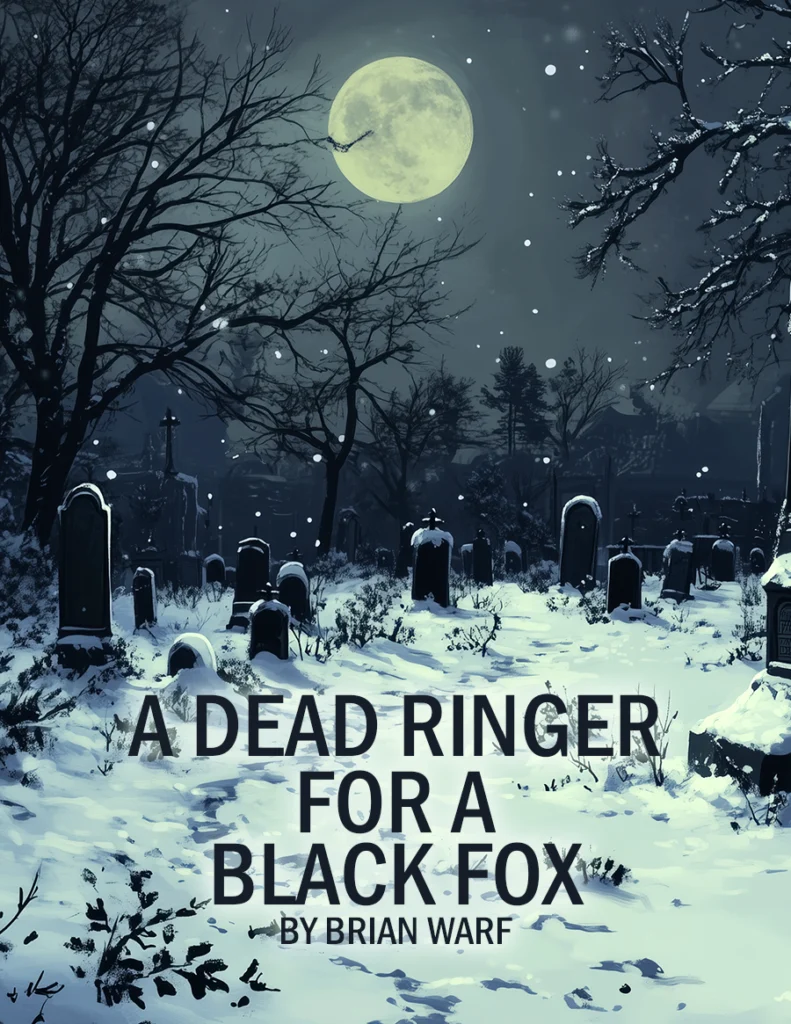
Errol Sheridan thought his time as caretaker of Henry Blankenship’s estate would be spent in solitude—until the black fox returned. A sinister omen, the fox leads him deeper into the mystery of the ringing bell, which calls out from Blankenship’s grave even when no one is there to pull the rope.
Only snow covered the top and skirted the bottom of the tombstone. The light then reflected off something just on the other side. Something that was small and shiny, glinting in the darkness.
When I stepped closer, I saw that it was a small bell dangling in the air, suspended on one end of a thin rope attached to a pulley contraption with the other end of the rope going into the ground. The bell suddenly began to ring, shaking and jingling as if by its own accord. I stepped around the girth of the tombstone, and the full sphere of the lantern’s glow fell across the grave. There, standing atop the freshly churned mound of dirt near the façade of the tombstone, was the black fox.
The bell rope was clamped between its teeth as it yanked and tugged, causing the bell to clang incessantly. I was not surprised to see him, for I’d thought of him as soon as I’d seen the tracks.
However, to my surprise, I found that it was this creature that had caused the bell to ring on that night and likely the ringing of the night before.
Though I had a pistol, it was packed away in my bags. I found the contraption to be very bothersome when trying to load with powder and pellet, so I hardly touched the loathsome thing. Yet, it was the second thing I thought of after seeing the black fox again. The first thing I thought of was making it leave.
“So,” I said, deepening my voice as I had the belief that it would make me sound more fearful.
“’Tis you making all this racket with this annoying bell. Hmmm?”
The fox looked at me, eyes blazing red in the sudden light, and it growled avidly, as if it were as annoyed as I was. Had I had the pistol on my side, I do believe that I would have fired it into the air or ground just to make the fox scamper off, for somewhat startled I was, but I did not yet feel threatened. In the very next moment, I did feel a threat from the little beast as I stepped closer to it. It let go of the bell rope, growled angrily at me, and snapped its teeth not once but twice.
“Here, here,” I said. “’Tis I who should be growling at you and snapping my jowls.”
The fox took a step toward me with its head bowed and eyes glaring. I raised my other arm up, even with the lantern, and braced myself, for I was sure that it was going to pounce. Instead, it trotted off.
I watched it run away until I could no longer see it. Relieved, I turned back to the grave and as the light fell on the tombstone, I read the name:
HENRY LEE BLANKENSHIP 1753-1842
I needed only to see the name to confirm whose gravesite it was. I’d already suspected as much from what Archibald had said to me of graves and local superstition and bells. Most importantly, I remembered that he’d said that Blankenship was the last to go at that time in those parts.
The lantern’s light hastily went out. It was as if a strong wind had stridden by. Yet, there was no wind to speak of. There was only the still of the moonlit night.
Unnerved, I began the long trek back to the house, which looked very small to my eyes at that distance. Though it was a large, righteous abode in the sense of aesthetic excellence. I trudged through the snow carrying the lantern that had become useless to me.
I had gone perhaps a hundred feet when the bell jingled for no more than two seconds. I halted and looked back toward the cemetery, half expecting to make out the black fox jumping around in there. I did not and thought it rather odd that the bell sounded out when still I felt no wind upon my skin, only the numbing coldness of the snow at my thin-booted feet. Surely, I thought, I would have heard the footfalls of the creature in between my own if it had gone back to the cemetery.
I walked on when the confounded bell tootled again. It was a series of rings that time, in three successions of several seconds apiece. Again, I stopped and peered blindingly at the cemetery.
I took a couple of steps back toward the cemetery and listened, waiting again to hear the bell. When I did not hear it after twenty seconds or so, I moved on toward the house and traversed the vastness of that snowy field for the second time. I had gone near another hundred feet when again I heard two chimes of the bell. Whereas there had seemingly been a sense of urgency with the first three rings as I’d left the graveyard behind, these two further rings sounded almost weak, for lack of a better word.
Once more I stopped and gazed blindingly the way of the cemetery. Though the moon was nearly full, it was too far to see any details and as I stood looking around in the dark, I surmised that I may as well have shut my eyes and I would have fared much the same.
I thought that it had to be the black fox again ringing that bell for whatever reason. I was tempted then and there to go back, run the fox off again, and take the bell for myself, yanking it free from the rope as if it were an unwanted weed amid a flower bed. As I stood there, contemplating whether to take the bell or not, I was getting colder by the second.
“Damn the little beast,” I thought.
I decided to hell with that fox and bell and resumed my path. Soon, I came near to the house, just outside a stone’s throw to the back door when I ran almost directly into the black fox. As I approached the back lot, I saw it sitting off to the side. I supposed that it must have taken a long route back across the field to the house without me noticing it in the dark. I was rather startled at the dark shape lumbering not fifty feet from me in the field as it stood up on all fours. As still as a doorstop it was, and though not very large, it was quite imposing in the dark.
I took a few steps more, halting near the rear veranda and just as the crunching sounds of the snow ‘neath my feet left my ears; the jingling and jangling sounds of the far-away bell entered them once more. Very faint it was this time and only lasted for perhaps two heartbeats. I looked back toward the cemetery, barely able to make it out in the moonlit void of the great field. I then looked at the shape that was the fox and something colder than the night sent a shivering chill up my spine. It was a thought.
If the black fox sits there, then who rang that bell?
Advertisement
This I contemplated for the remainder of the evening as I found myself sitting and stoking the fire in the parlor, too unnerved to go right back to bed.
Nearly a fortnight came to pass, and I did not see the black fox, nor did I hear the tootling of the bell. I had fallen into a routine of performing my daily duties and reading in Mister Blankenship’s library, for he had an extensive collection of books, many of them from foreign lands. I sometimes read in bed at night until I fell asleep, and it was on one of those occasions, some thirteen days after I had arrived, that I saw something that remains etched in my mind to haunt me unto my dying breath.
Now, I am not much for drink, other than a sip or two of wine at social gatherings; so, it was out of pure boredom when I had a bottle of whiskey delivered to me along with my regular goods from the general store. It was brewed by J.W. Wadsworth, a fellow out of New York who had just recently started pushing a sauce he’d invented for slathering steaks. A sauce for steaks? Who had ever heard of such a thing? My point is that the bottle of whiskey had come from a highly reputable place. It was also tightly-corked, so I do not believe it was tainted with any mild poisons. I do not believe that there was anything in the bottle added to the straight whiskey to make me have the first of several hellish visions that I saw starting on that night. It came to me much like a fever dream. Though, I was not sick and thus, had no fever. This first terrible vision I will tell you of now.
It began, I suppose, with the uncorking of the whiskey bottle and pouring myself a few drops. I sipped on the spirits for no more than a half-hour or so in the parlor next to the crackling fire with a book in my hands. Having had only a few sips, I was far from drunk, only sleepy and relaxed I became and so went upstairs to the master bedroom to retire. All was quiet until I heard a sound that interrupted my slumber and jarred me slightly awake.
The bedroom door creaked open as if the hinges themselves were yawning. I heard a pattern of footfalls tapping and scraping across the floor from the door to the foot of the bed. Still, I was not awakened fully and it was then that I heard the distinctive sound of a man clearing his throat in an ‘ahem-harumph’ not once, but twice.
Even still, I could not fully awaken. The blankets were then lifted from my upturned feet, and I felt ice-cold fingers poke both, for I was lying flat upon my back. My eyes stirred ever so slightly, the lids seeming to me then heavier than they had ever been in all my days. When I opened them, still not fully aware if I was asleep or awake, I could see the orange, flickering glow of the fire in the room’s fireplace staving off the darkness.
At the foot of the bed, there stood the black shape of a man. His staring eyes were shimmering like two small burning coals floating in the air. I was terrified, but still, I could not fully awaken or even move. Though, the black shape could move, and it did, walking from the foot of the bed to just beside me before coming to a halt. Into the glow of the fire, this thing came, and it no longer reeked of shadows, for I could see its form as it truly appeared.
It was the spirit of one Henry Lee Blankenship. I had never met the man, but I knew in the depths of my soul it to be true that it was him. Rather, what was left of him. I recognized him from the oil portrait of Blankenship that hung in the parlor above the fireplace. The form beside me stood tall and thin, but hunched in a fancy, black burial suit. White hair capped his head, his eyes sunken within dark circles. His jaws were also sunken, the skin as pale as a cloudy afternoon. He smelled of musty earth and death.
I wanted to ask him what he wanted of me just as much as I wanted to know whether I was dreaming or not. Being unable to move, I was also unable to speak. I then heard the hollow voice of Blankenship’s remains.
“You sleep in my bed?” the spirit asked angrily with a scowl. His voice was equally as cold as his hand.
I could only move my eyes, and they stayed fixed on this pale ghost, never wavering. I could not even gasp.
“You sleep in my bed?” the spirit repeated. “And you did not answer my bell… You did not answer my bell… You did not answer my bell.”
Blankenship’s specter leaned over and lifted his arms toward me with his long, crooked fingers outstretched. The hands slowly came toward my neck.
“You did not answer my bell.”
Upon closing my eyes and gritting my teeth, I felt those cold, dead hands of Mister Blankenship wrap tightly around my neck. As soon as I felt the thumb bottoms press firmly against my Adam’s Apple, the sensation subsided. I opened my eyes again, and the specter was gone. So too did his smell leave after it lingered in and out of my nostrils for perhaps half a minute.
I am not ashamed to admit that I was too frightened to move at first. However, move I did, and I raised up in bed and looked around the room. Save for the immediate vicinity of the fire, it was most dark and drafty in the vastness of that bedroom. I stood crossing my arms and holding them tight as I went about the room.
Nothing seemed to me then to be out of place. I sat down on the edge of the bed, at a vigil I suppose, for half the night until I fell asleep, and it was unbeknownst to me when I did so. I woke up sometime after daybreak, feet flat on the floor, slumped over on my side with a stiff neck and sore back.
I dismissed the occurrence as nothing more than a ghoulish nightmare brought about by the consumption of the devil’s dew. It was the drink and the fact that I’d eyed the painting of Blankenship quite a number of times since I’d spent so much time in the parlor with a book. Though, the presumed, imagined spirit of him, I thought at the time, appeared just a bit older and frostier; it more than resembled Blankenship’s portrait. I thought at the time that this oil on canvas imagery also influenced my vision. How wrong I was I would soon come to find.
In the days to come, the snow moved on further North. It remained cold for those dry and windy days. So cold in fact that I had gone through more firewood up to that point than I had initially estimated.
Just three days removed from the Blankenship ghost incident, I decided to chop more firewood whilst it was rather sunny. By the time the sun began to dip down in the West, I had amassed a good pile of chopped wood. When I finished, I stood straight to soothe my aching back and looked at the woodpile, proud of myself for the burn-ready accumulation of small logs.
As I rested I saw something move in the field not far from me. I turned and saw none other than my frequent visitor from just over a fortnight before. It was the black fox once again. I presumed it was one and the same animal I had seen before since ‘tis such a rare occasion to see one.
It sat undaunted and still as it stared my way. I too stared back at it, which I probably should not have. Wild animals, they say, do not like it when a man makes eye contact with them, and its yellowish-orange eyes seemed to stare right through mine. I looked away and decided it best to look at him with glances instead. Then, it did the strangest, damned thing imaginable; it wrinkled its muzzle and growled at me not once, but twice. And with no provocation whatsoever on my part. Up until then, I thought we’d had a sort of mutual rapport. It turned up its bushy, black tail then and promptly headed for the woods.
That night as I slept warm and snug in a dead man’s bed, I was awakened by a chill in the air that ran lightly across my face. I opened my eyes and looked to the foot of the bed. Seeing nothing but the glow from the fire, I lay my head back down on the pillow. No sooner had I closed my eyes than I felt a wind again.
I looked across the room between the door and the fire. It was there in the flickering light where stood six small figures. Four girls and two boys, dressed in tattered rags, stared down at me with shimmering eyes and pale, blank faces that bore no expressions other than that of somber melancholy. I estimated their ages to be between six years and twelve years, a blonde girl looking to be the eldest. There was something else of them I noticed that was as strange as them being in the same room with me. When the light from the fire played on the wall behind them prominently, I could see through them.
I could also move freely, unlike the time of several nights before when the specter of Blankenship paid me a visit and I was frozen with shock. However, I was equally as shocked on this occasion, but chose only to raise up in bed. Though, just as with the otherworldly visitation by Mister Blankenship; I was unable to speak, as if the ability to do so was momentarily suspended. I could only gasp and even then I found it very difficult to take in a breath to do so.
Advertisement
“We have no bells to ring,” the eldest girl’s spirit muttered in a far-off tone.
I looked at her with bulging eyes, unable to respond.
“We have no bells to ring,” repeated the youngest-looking spirit, a boy, and in the self-same, monotone manner of the girl.
Dumbfounded I was to be in the presence of these ghost children.
“We have no bells to ring,” all the ghost children said together.
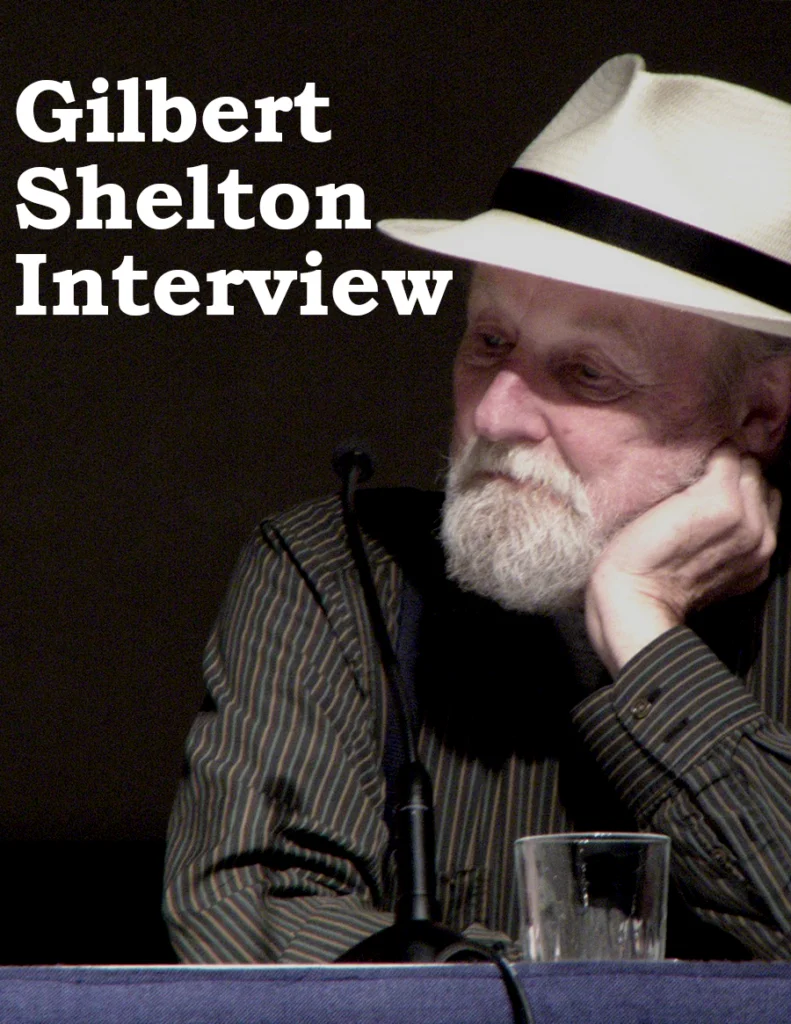
Few names carry as much weight in the world of underground comix as Gilbert Shelton. From the psychedelic streets of 1960s Austin to the countercultural hubs of San Francisco and Paris, Shelton’s creations—most notably The Fabulous Furry Freak Brothers, Fat Freddy’s Cat, and Wonder Wart-Hog—have become iconic symbols of anti-establishment wit, wild storytelling, and absurdist humor.
Hi Gilbert. We appreciate you doing this interview.
I hope we can come up with something interesting.
Can you tell us where you were born and what is your background?
I was born in Dallas, Texas, on May 31, 1940, and I grew up in Houston where I lived from 1945 to 1958.
Were you always creative as a child?
I learned to read early, but I wasn’t especially creative.
What started your path to comics?
The daily comic strips in Houston’s newspapers the Post and the Press.
What were your favorite comics or characters as a child?
In the papers, Dick Tracy, Little Orphan Annie, and Smilin’ Jack. In comics, Donald Duck, Scrooge McDuck, and Little Lulu.
What are your favorite art techniques?
Pen and ink and watercolor.
Do you use any shortcuts to hit deadlines?
Stay up all night, sniff cocaine.
(Laughs) I guess that would do it.Where did the idea for Wonder Wart-Hog come from?
I had a dictionary with a picture of a Wart-Hog.
You worked for the magazine Help! What was it like to work with Harvey Kurtzman?
Kurtzman was a brilliant editor, very helpful. He could make suggestions for improvements without being overbearing, although this editorial attitude led to his breakup with John Severin.
Harvey KurtzmanHelp! March 1965
You published Frank Stack’s The Adventures of Jesus, one of the first underground comix. Did you get any flak from religious groups?
The Adventures of Jesus was the first underground comic. No one ever complained about it on religious grounds. In fact, it was pro-Christian in a moral sense.
Frank Stack
Now we must talk about The Fabulous Furry Freak Brothers. What inspired that comic and its characters?
I saw a double feature film show at the Vulcan Gas Company in Austin, with the Marx Brothers and The Three Stooges. I can do as good as that, I thought, and I made a twenty-minute film with a film student friend of mine, Renée Tooley, called “Texas Hippies March on the Capitol”, and I made the first Freak Brothers page as an advertisement for the film. Well, people liked the comic strip better than the film, the only copy of which has been lost, so we cannot know, but it turned me toward cartooning.
I remember seeing there was a Freak Brothers cartoon. Did it ever come out?
There have been several Freak Brothers film projects over the years, none of which came to completion. Currently there is a television series.
You are among the main icons of underground comics. Did you feel you were part of a movement?
Advertisement
There was no common aim of the underground cartoonists.
Did you experience any problems with censorship?
No.
In the underground comix affiliation, did you guys get along? Was there camaraderie?
I knew and liked all the underground cartoonists personally, although there were some whose work I could not read.
If anyone wanted to break into comics, what advice would you give them?
Get a day job and work on your comics at night.
What about independent publishing? What advice would you give?
Three-fourths of the work of publishing is distribution.
What projects are you working on now?
I have a rough idea for a NOT QUITE DEAD story: Saturday Night at the Kaos Klub. Also, I’m doing some new Fat Freddy’s Cat pages.
In a small Appalachian town, one man’s relentless determination brings an 80-year-old theater back from the brink. Through community, creativity, and countless grants, a historic movie house gets a second act—this time with digital screens and old-school charm. Come meet the man behind the marquee.
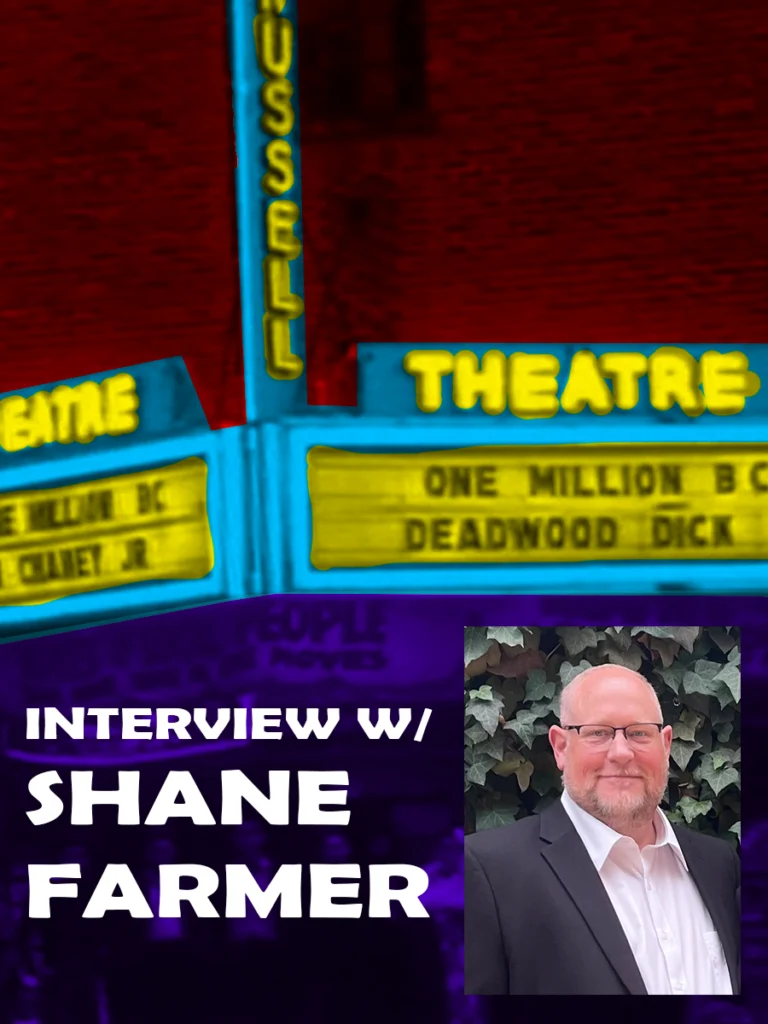
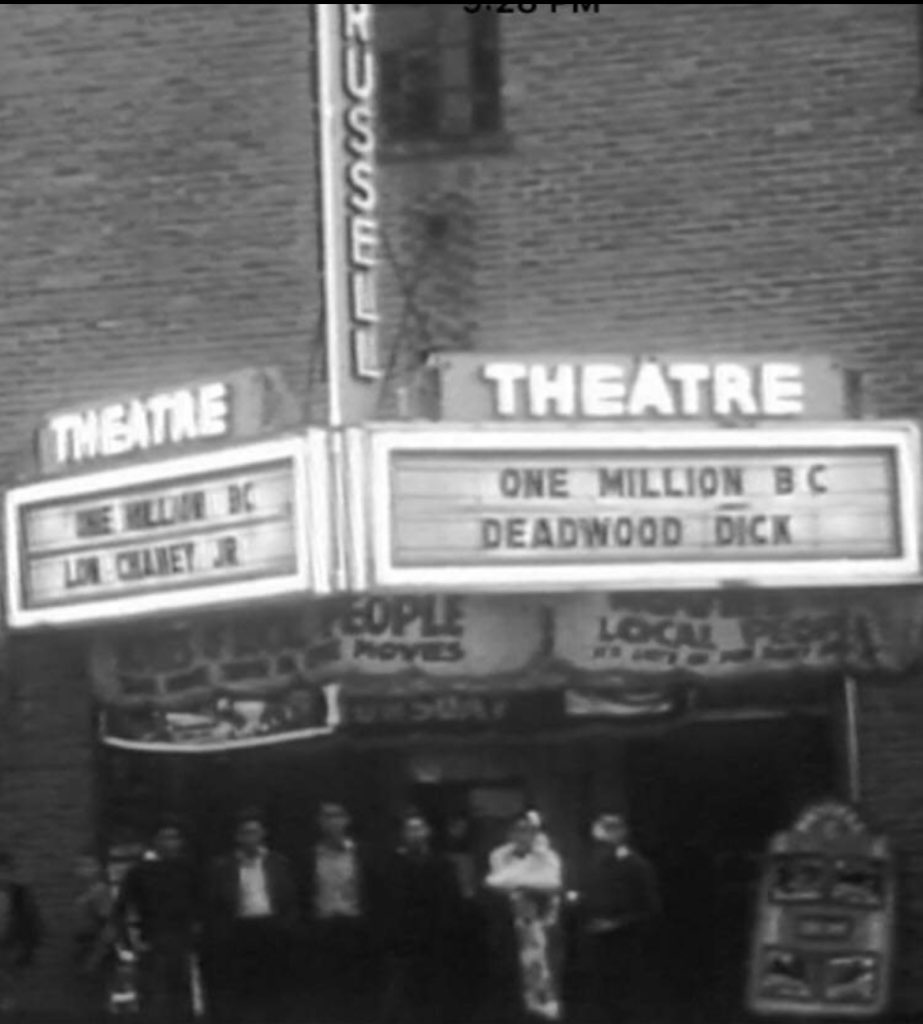
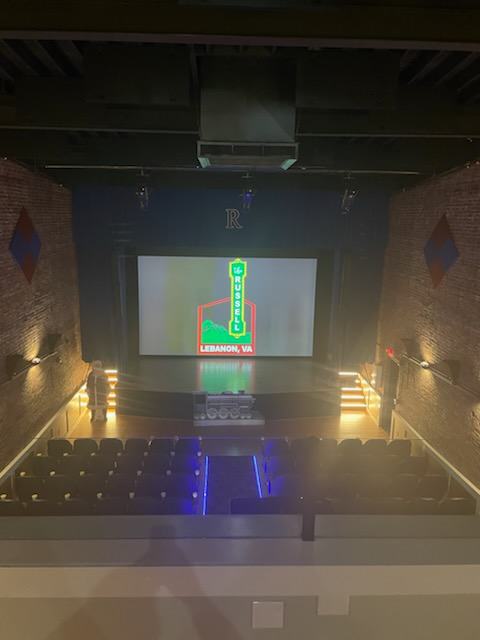
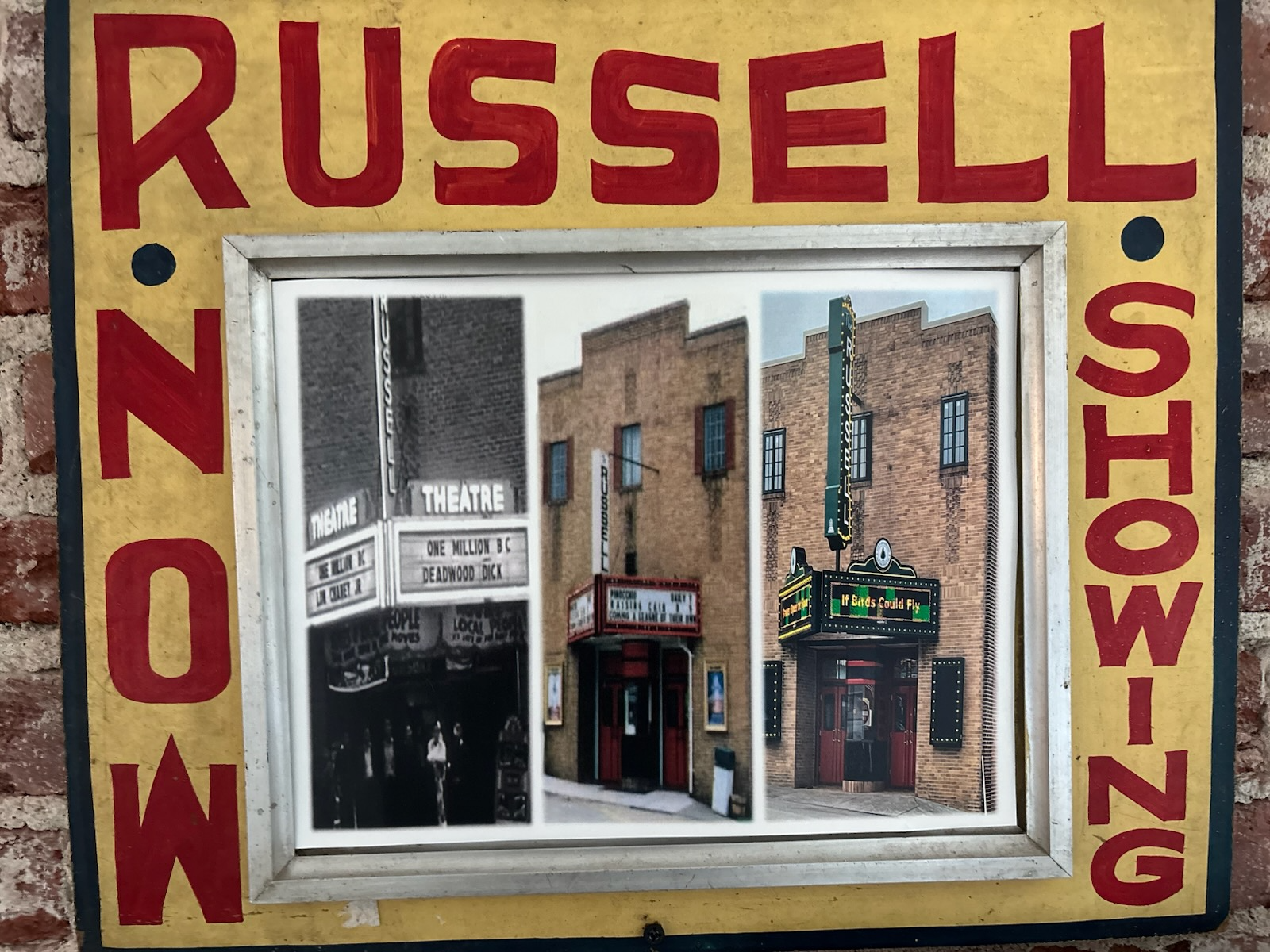
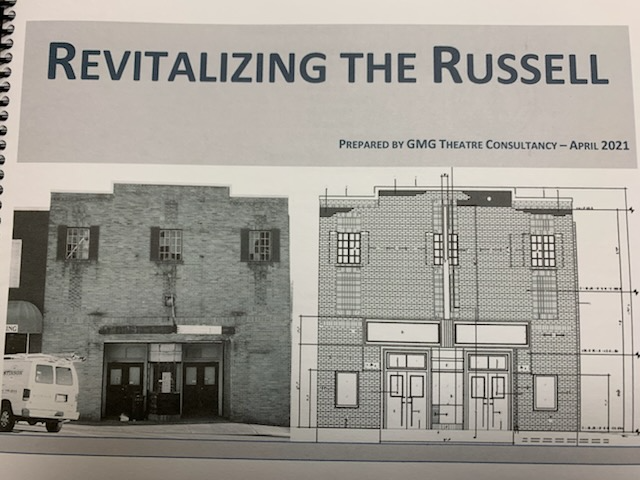
Twisted Pulp Magazine’s own Mark Slade recently sat down with Shane Farmer, the director of the historical Russell theater, here in Lebanon, VA, a community movie theater that recently reopened two years ago. Shane is showing me photos of when the theater was first constructed and opened over eighty years ago.
How did you become the director of Recreation and Parks and the Russell theater?
I applied, when the town did the recreation center, they were looking for a recreation director. My degree from college is in leisure service and recreation. And then I had all that planning, you know, planning at the planning district, from 23 years, yeah, so I applied to work for the town.
I’m the first ever recreation director for the town as well. So and, but they wanted me to continue to write grants for the town.
I’ve written over, probably since I’ve been with the town, counting the million dollars we got for the downtown revitalization, we’ve probably gotten close to $3 million in grant dollars.
Wow, that’s a lot of money.
Yeah. And some of it’s gone to this, some of it’s gone to some other stuff, the Pavilion right beside us. We built that to give us a little bit more space here, and sort of to do some things outside and like, we’re going to do some dinners in the shows right there on the pavilion and come in and have a film or a show or whatever. We can turn it into a spirit garden one weekend or something before a show, stuff like that. Yeah, so, and I’ve written grants for that, and we’ve gotten over $65,000 in grants just for the pavilion. So, you know, I’m always writing grants for the town and for all our projects, really, and so I continue to stay on and do that work as well. I’m still writing grants here. Like I just received a $5,000 grant for advertisement. I just applied for another one. Advertising is really hard, it’s really expensive.
I may have an extra copy that I can share with you, from all indications, it seems like the years between 1939 to 1940 range from when the facility was built and opened up. And some of the history behind it is, I mean, it was just, it was one of the first ever movie theaters that had air conditioning in it.
Oh, wow.
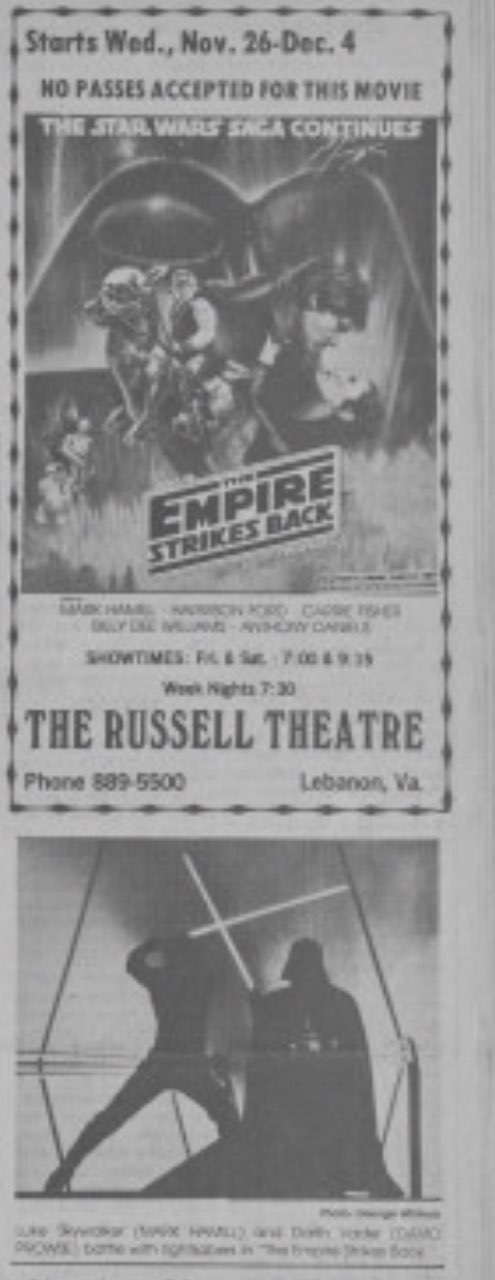
And one of the ads, I’ve got it here somewhere– in this book, but one of the ads even shows that I was going to show you that, and it’s, this. It’s the first movie that’s shown here. And it says, you know, in the Russell theater with the air conditioner.
I can only imagine how huge those machines were.
It was opened and reopened several times, reopened in 1991 afterwards.
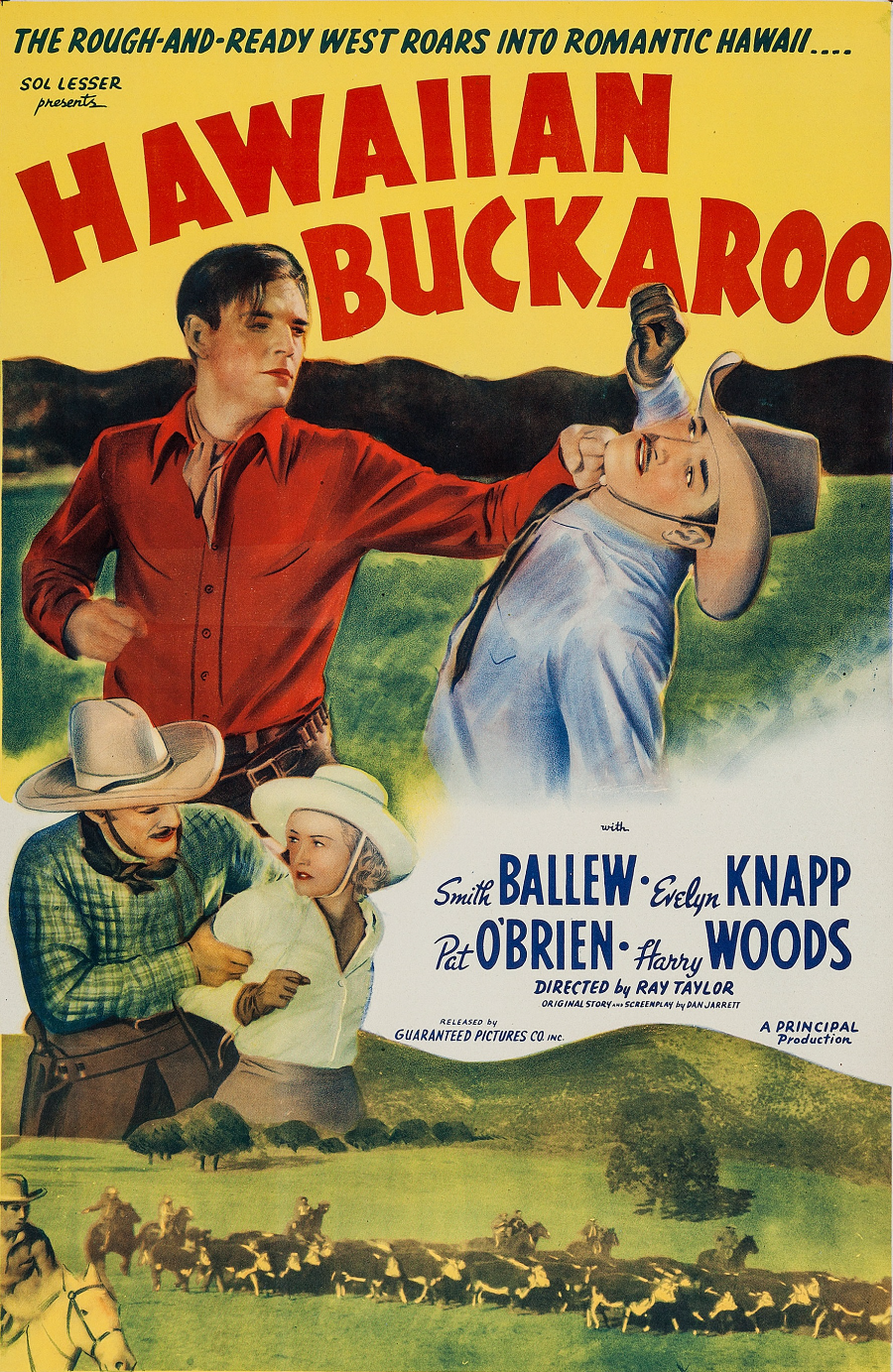
But it looks like, to me, and the stuff that we’ve got, that the first ever movie shown here was Hawaiian Buckaroo.
I’ll have to look that film up.
Which was a Western, and it was, I think they even had a double feature and had a Betty Boop cartoon with it and stuff like that. So, but yeah, here’s that little ad. It says air conditioned, stay cool at the new Russell theater, and it says big double feature, and that was in 1939.
Oh, wow, yeah.
So it was one of the first of its kind to have, you know, to have air conditioning and stuff like that.
Where was the original area they showed films?
So this used to be the actual film room that you’re sitting in here that’s turned into the office. So, it’s a regional brick on the back wall. I asked them, let’s keep that, because it looks really nice. All that’s original. The marquee was almost identical to what’s out there, just a little bit shorter, but it had the 3-D Russell theater on it. And so when we built the marquee, we wanted it to have the 3-D Russell on it as well,the sign from other openings was just a flat glass.
We wanted to go back to more of a historical look and what it originally looked like. And that’s what we did for that. But I mean, it’s just, it’s amazing. You know, looks like, here’s something that the Richmond Times Dispatch did a story on the construction of the theater. It looks like 1938 so we’re looking at the 1938-39, 1940 range, before it was open.
That’s pretty interesting. You know, that’s a long way for somebody to travel. Especially back then, right? You know, that’s way before they even had the Interstate, right?
It’s probably just two lane roads or one lane road for most of it. We’ve read out to find old photos of the theater, too
Yeah, this is all the shows that we’ve done since we re-opened. This is the stuff that the talent has signed.
We’re excited because we feel like we kept the historic look of the old building, and that’s what we wanted.
The movies are not projector anymore. They’re digital.
Advertisement
We’ve got state of the art equipment. We still show movies. It’s expensive to show them. Don’t get me wrong. We got our sound, their lighting, we got video capabilities, too. I mean, that stuff’s all state of the art and top notch.
Oh, okay, so that was one of my questions….
So expensive to show projected films anymore, to buy that equipment. So, and it usually, to be honest, it’s hard to keep up. Yeah, so we went with a really expensive high definition video, and it’s just, it really looks phenomenal.
How do you get the film? So you contact distributors, or they contact you?
There’s, there’s three or four different little agencies that have the copyrights to all of them. We have to pay for those copyrights. The copyrights are not cheap. People don’t realize, you know, even here, I can’t even afford new run Movies.
I get secondhand or, you know, older movies, or a lot of times I try to get what’s just coming to streaming and show those.
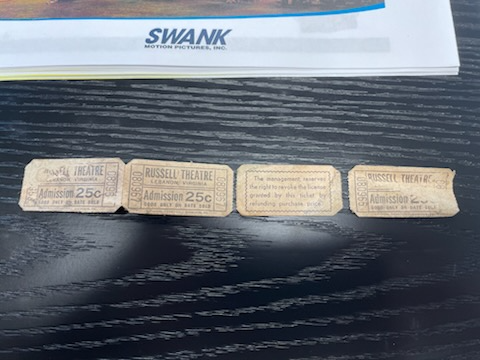
But to get a movie, one agency which has the most copyrights is called Swank, and they’re out of Chicago, and their fee for me to show a movie one day is $360. Now, I can show that as many times as I want to, okay, but it’s still $360 and, you know, we’re a small theater, small community— I don’t make that money back most of the time.
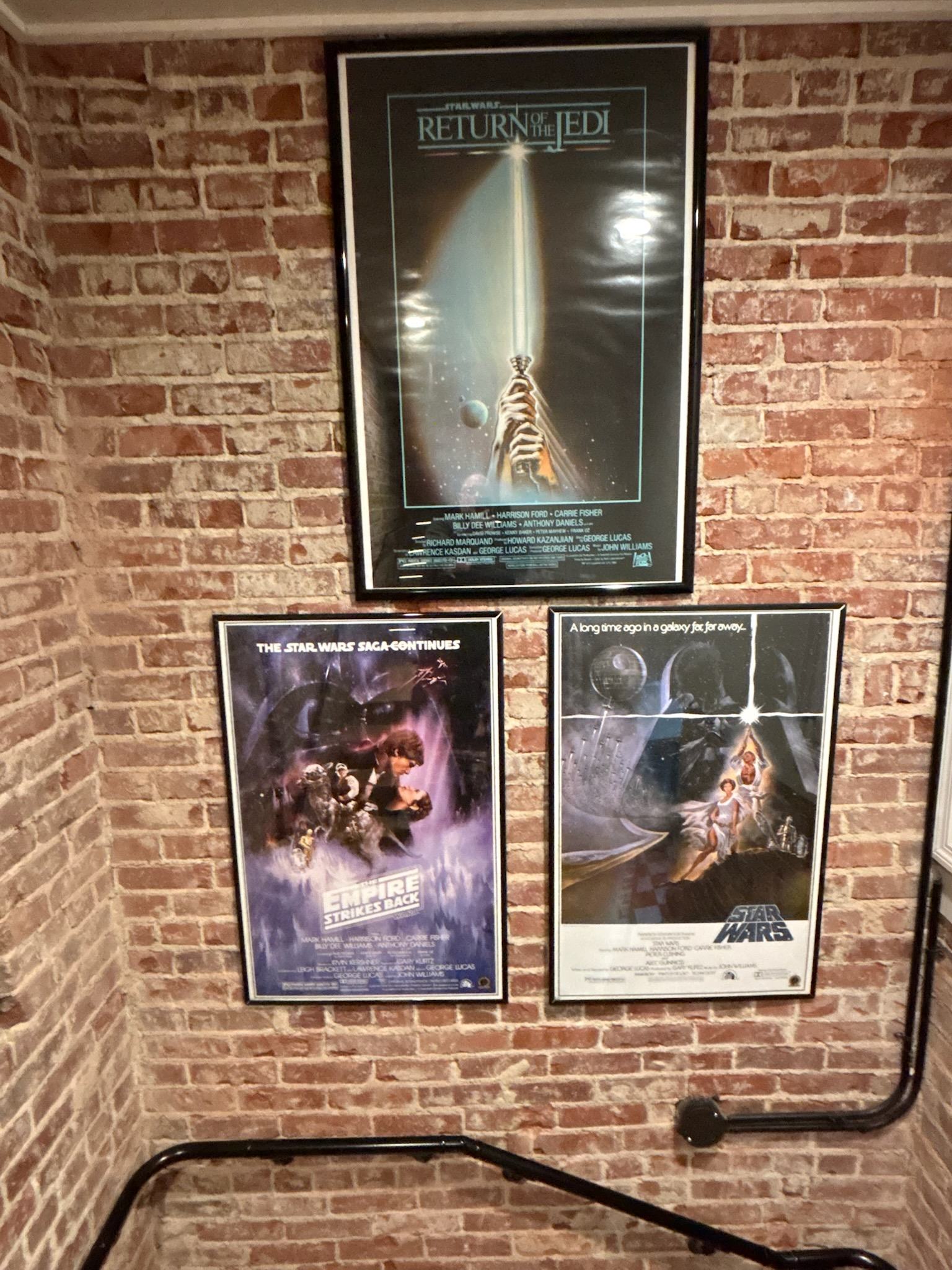
There are, I have found, some other agencies that do the copyrights and like, I have to go through, like, I’m doing Star Wars in May, . I’m doing Episode One and two, and I wanted to do three, but I can’t do three because it’s the anniversary of Episode Three, and they’re releasing it back into big theaters. So the big theaters block small theaters.
That’s not right.
Yeah, it’s really not.
And I know they pay a lot to reintroduce that and, and, you know, today, even those bigger theaters and first run movies. A lot of times you go, and there’s not a lot of people.
So, the movie theater industry is really….I don’t know how it’s staying alive, be honest.
It’s really hard for us, and we’re paying $360 and they’re showing multiple movies first run in multiple theaters.
I really don’t know how they’re how they’re staying above water.
The entertainment business has gone down the tubes a whole lot in the past 20 years, because they just don’t try very hard.
Yeah, and I was talking to my wife about that the other day, I was like, you know, the movies and stuff just not what they used to be.
Well, even the titles are just awful. It’s like, one word titles, and you’re supposed to go, I want to see that. I don’t understand the marketing strategy behind that.
Yeah. I mean, there’s literally when you see, yeah, there’s not a lot of films that you want to go see. No. I mean, I’m like, do I want to pay 20 bucks to go see it?
The filmmaker, Joe Dante, I don’t know if he still runs this, but he used to run a website Trailers from Hell, and which shows a lot of older trailers, and a lot of them, he actually cut and edited himself because he worked for Roger Corman; and how he put it, about modern trailers, they show everything.
You know, you find that jewel of a scene, edit it, you find another one, put it together, and then maybe a voiceover and something to get people excited.
I’ve noticed, at the Russell theater, some of the older films do better.
I showed Goonies last night.
That’s great!
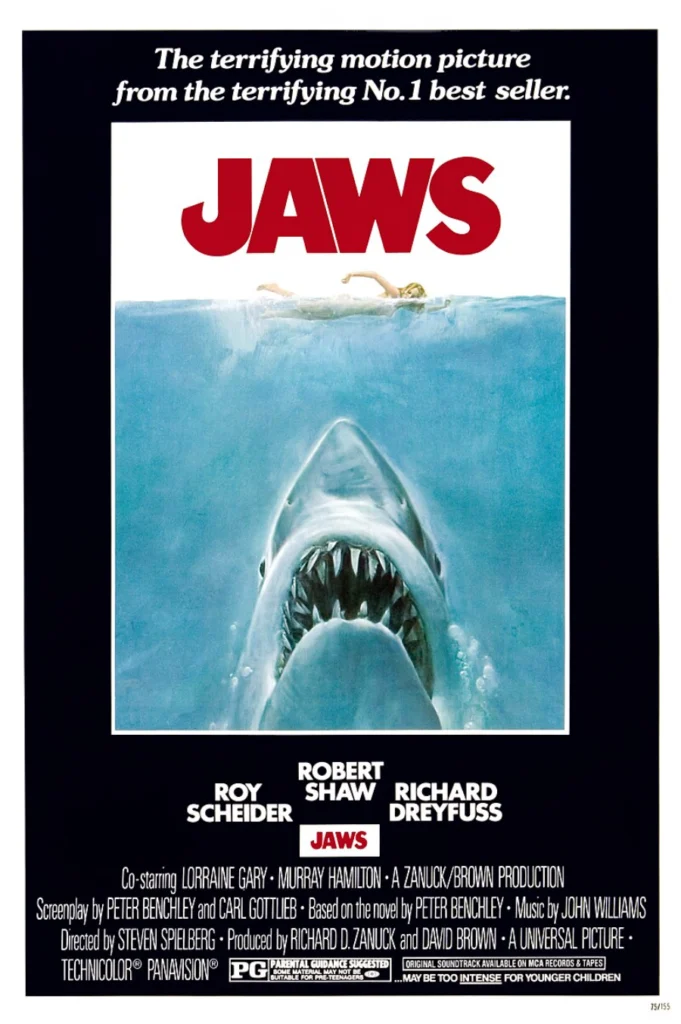
Jaws last summer. I would love to show Jaws again, but they’re gonna block it again because it’s the 50th anniversary.
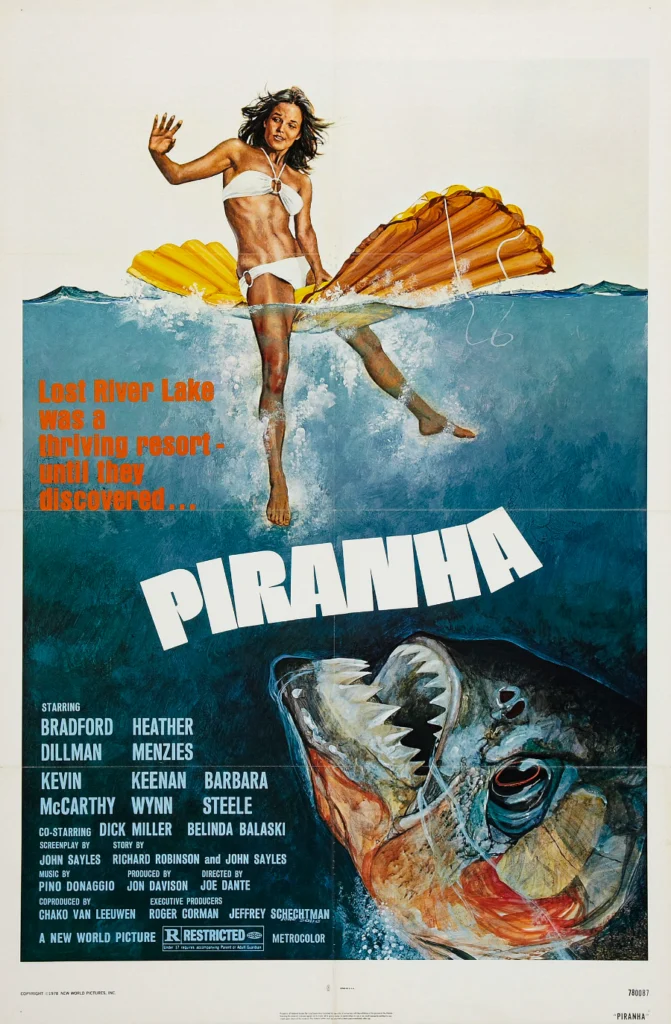
How about, have you ever thought of the knockoff Jaws movie. Piranha would be a good one.
Advertisement
We may very well do that, especially since summertime is around the corner. Last year was our first year of what I called “Blockbuster movies at summertime.”
We just picked movies and showed them. We advertise away ahead of time and stuff. But I try to pick stuff I feel like people want to see. And it looks like some of the older ones are what people really like to come and see.
I will try to do some series. Some of the teenage kids said, do some series. We’ll come see them.
They didn’t come.
I try to do things for them, but when they don’t show up, it costs me money.
I did, what’s the vampire series? Twilight series. Yeah, I did the Twilight series, I think, seven films, and I got a lot of films, and it cost me $1,500 to show that, and we had five people all week.
We did Hunger Games, same way, and we had about 19 people the whole week.
I did show Back to the Future trilogy.
That’s a good one.
I did that, and we had a really good weekend with that, yeah, because it’s a three day series. So
Do you do better with, like, sort of PG 13, that’s…..
I have been showing some R rated films.
But not a lot.
Yeah, I saw where you, you advertise, Unforgiven.
We had a Gene Hackman weekend when he died.
Hoosiers and Unforgiven.
We did a Coen Brothers weekend.
I would have loved to come to that.
I know a lot of people love that idea, and a lot of people came, I did three different movies on three different days.
Which Cohen brothers films did you show? Because you got, like, 20 films to choose from.
Yeah, it was hard to pick. And that’s what I said on the social media post. It’s hard to pick through. But, you know, I picked The Big Lebowski for Friday night, and then Saturday we showed O’Brother Where Art Thou.
Then we showed Raising Arizona.
I thought raising would have a good turnout. It was on Sunday. Sundays are a little hard here sometimes. But Raising Arizona, I thought people would really like that. But, you know, I think that’s one of Nicolas Cage’s better movies.
I just picked three random movies and the first two days did really well. Sunday, not so much.
Well, you got a lot of competition. Church, internet, streaming, sports…..
Advertisement
Oh, yeah, we do. And, you know, and you know, it’s, it’s hard to get folks to understand, you got to come and support us. Yeah, you know, I’m only charging five bucks for a movie.
So we’re, we’re not making much money. This past weekend, we showed Wicked, which is very popular, and, you know it’s, it’s brand new to streaming and everything. We probably had 50 people all week. That’s pretty good for us. We count that as a pretty good weekend.
I’m just getting my feet wet,
We opened up in 2023, September of 23.
Y’all started construction probably in like, 2019?
Yeah, 2019 finished up in 23 takes a while. Well, you had all those COVID years. Oh, that’s true. And you couldn’t get materials. You couldn’t get it, you just couldn’t finish stuff. So, but we were right in the middle of COVID when we were trying to rehab the building and refurbish the building. So, but you know, I try to listen to the community. I’ve even started a new group called Friends of the Russell, and it’s got about 10 or 12 folks that I basically hand picked that, you know, came to stuff here at the theater and supported the theater or sponsored something at the theater, and I wanted those folks involved. And we started that basically in January, and we just had our third meeting. Oh, so we’ve been meeting on that.
As I said, I want your ideas, because I was like, I’m doing all this.
I’m also the director of Parks and Rec.
I saw that on the Russell theater website.
I’m the director of this, so I’m doing a lot. When I say I’m doing a lot, I’m doing a lot of it by myself, I need the help.
As far as the chat group, and if anyone has an opinion, or a suggestion, I’m going to listen.
If we can do it, we’re going to do it.
I’ve really tried everything here.
We’re doing ballet next week. I’ve got a concert tonight, classic rock, and then Wednesday, I’ve got Bristol Ballet coming and doing their spring performance. They’re not doing the full show, but they’re doing about a 30 minutes, 45 minutes snippet of their Alice in Wonderland show.
I’m trying to bring all the arts in here. The only thing I haven’t gotten done yet is a stage performance. Oh, and I’ve got that coming in November. I’ve got the Barter Players coming to do two shows this November.
It’ll be a Christmas show in November.
I just want to reach out and give the community what it’s never had before. That’s what it’s all about. It’s a community theater. I love doing this for my community.
It’s sometimes hard because you feel like you’re putting all this work into it, but nobody’s coming, but I will say it’s starting to pick up now. This show is sold out, Bad Moon Rising/ Creedence Clearwater Revival cover band.
The council that funds this, you know, this is owned by the town of Lebanon, right?
Yes, not many theaters are owned by the town.
It’s starting to be a little better because folks have got those grant dollars and everything in order to rehab their old downtown, dilapidated theaters, just like Saint Paul (Va.) did.
If the council sees that the community and folks are going to come here (the Russell), then they can justify putting money in. So it’s budgeted every year. I’ve got a budget I go on, and I have to stretch that budget from, basically, it’s over in May and it starts over in June, the closing of a fiscal year, and we’ll open up another one.
You project the films—
It’s all digital.
I’m getting ready this summer. We’re doing what we’re calling Early Bird specials. That’s going to be during the daytime.
Advertisement
Oh, that’s great,
Because we’re not utilized in the daytime, but I’ve reached out to senior citizens and senior citizen groups. And we’re going to do like we’re calling early bird specials, they’re either going to go eat a meal somewhere in town, like breakfast or brunch or lunch and then come here to see a classic film.
That’s something I’m working on right now.
And the group that’s, you know, the friends of the Russell helping me do that as well. And some of those ladies are senior citizens, and they want to be a part of that. And they’re the ones that’s sort of driving that a little bit they’re excited about it, like, like, I showed them, I just got that finished the other day, and I showed them that, and I’ve got the actual movie poster coming out that I have framed, and I’m gonna put it down in the lobby as you go down into the theater.
They were like, is there a possibility that we could see Gone with the Wind? I said, Absolutely, yeah. I said, if you want to sit through that long of a film, I’ll show it to you.
Can you tell me about the Storytelling festival that you and Jerry Sword are putting together?
On October the 11th, we have our second annual Tales from the front porch. It’s a Storytelling Festival. Oh, and it’s those stories and folklore, and so that’s interesting. Yeah, it was really good last year. We had real good turnouts.
We want to keep growing that.
We’re excited to do that again. And it’s really top notch storytelling. And, you know, I said here, it’s an all day event, and it’s really cheap. Last year we charged $15. I think we’re going up $20 this year. But We even include some local music in there too, folks that tell stories when they sing their songs and stuff.
The authors sell their books and stuff right there on the pavilion. That’s another thing we’re gonna continue to do.
That’s pretty cool.
It’s really, really a neat event.
That’s something that’s not really done here in the area, except for, you know, you hear about Jonesboro, Va. Jonesboro canceled theirs last year because of Hurricane Helene.
We got ours about two weeks after theirs, and we even had some folks from Jonesboro come over. So that was pretty neat. I think it’s something that can grow and get bigger.
Oh yeah, definitely.
It was just really neat to have folks on stage telling stories, telling ghost stories, telling with some we had a guy that writes books about the coal mines, which is right here in the area, and he talked about being in the it was actual stories that he lived and talked about being in the coal mines by himself, and stuff, weird stuff happened. And, you know, it’s just neat stuff.
In this bizarre and humorous short story, a man wakes up to discover that his brain has been transplanted into the body of a gorilla.
The man began to awake slowly, in a stupor, feeling like 200lbs of soggy elephant dung. He had far too many questions running through his mind, “Where am I? What happened to me? Who am I? If God and Superman had a fight, who would win? So, so many questions. All he knew was he seemed to be lying in a bed in a dimly lit room.
“Uh oh!” he thought to himself, “Not again!” A faint memory began to form in his mind. The last time he had felt like this was a few months earlier, in early 1950, when he had awoken one morning, naked, on a straw mattress in a thatched hut. He was in bed with an equally naked, toothless sixty-some-year-old Korean grandmother, a very contented-looking female dog, two ducks, and a spilled plate of pork dumplings, complete with dipping sauce. He was glad he had no memory of the previous night but was sorry he couldn’t recall eating the dumplings. He really loved dumplings.
Then another memory relating to that one popped into his mind. He and his squadron of B-29 Superfortress flyers had landed in South Korea. His job was tail gunner, and his somewhat uncreative nickname was Tail Gunner something or other. Tail Gunner Pete? Tail Gunner Frank? No, that didn’t seem quite right. It would probably come back to him eventually. It was his name, after all. The only thing he could remember was that he and his buddies had decided to go out and have one last bout of hellraising before they had to begin their bombing runs, which were scheduled to take place later that week. He had no idea how much he had to drink or how he’d ended up in that bizarre situation with madam gum-flapper and her barnyard menagerie.
That was how he felt now; confused and disoriented, yet at the same time, he was surprisingly quite strong, perhaps stronger than he had ever felt. He tried to sit up but found himself strapped to the bed. Wherever it was he happened to be, the great strength he now felt wasn’t going to do him any good. He couldn’t move his head and couldn’t see anywhere but the ceiling directly in front of him. He was relieved that the roof was not thatched but appeared to be some sort of metal roof, perhaps a hospital or laboratory. A thatched roof and restraints might signify something much worse than that previous embarrassment.
“Whew. Dodged that bullet again.” He thought, recalling the morning after the incident with the old woman. Much to his dismay, her dog had followed him back to the base, constantly rubbing against his leg. He obviously had made an impression. He had to chase her away and then felt a bit sorry that he didn’t even get her name; the dog, not the old woman.
There was a bad smell in the room, like wild animals, like the stink of a zoo. Was he being held captive in a zoo somewhere? He felt the air in front of his face flutter as if a bird had flown close enough for him to feel the flapping of its wings. He heard a wild chittering sound made by a squirrel, and it was also frighteningly close to his face.
He realized he was hungry and was having strange cravings. Not his typical need for cheesesteak sandwiches or pizza but for food and fruit he usually hated. He wanted a salad, a really big, really leafy salad. He also had an unexplainable craving for bananas, not just one, but an entire bunch of bananas.
Then a soft voice came out of the darkness, saying. “Ah, so I see you’re awake.”
“Y… yeah… I’m awake.” The confused man said slowly, intending to say more but shocked at the sound of his voice. It was deeper than normal and had a somewhat raspy quality, catching him by surprise. It sounded like a female impersonator doing a bad impression of Cher. He also noticed that his head felt like John Bonham and Keith Moon had a drum-off inside his skull. “Where… where am I? What the Hell is wrong with my voice?”
“Oh yes. Questions, questions, so many questions, I’m sure.” The other voice said, sounding surprisingly cheerful. “I assure you all your inquiries will be answered in due course. I, too, have plenty of questions, my new friend. For example, what’s your name?”
The man thought for a bit, trying to fight through the thick cotton candy fog clouding his mind. Then it came to him, “J… J… Joe. I think my name is Joe. That feels right. Yeah… they call me Tail Gunner Joe.”
“Hum.” The voice said, “I suppose that makes sense, all things considered. However, I would have pegged you for a Waldo or maybe a Wendel. Then again, I suppose Tail Gunner Waldo doesn’t have a very good ring to it. Well, Tail Gunner Joe, do you happen to know your last name?”
Joe replied, “Of course. Sure, it’s… it’s… huh? I got nothin’. Maybe it’s Smith.”
“Really? Smith? That’s the best you can come up with, Smith? Not the most creative sort, are we?”
“Forgive me all to Hell and back, but I’m not feeling quite myself here. You know what I mean?”
“Oh yes. I most definitely know. More than you may realize. Well, I suppose we have to call you something; how about Simian? Joe Simian. That feels right to me. How do you like that name?”
“Simian? Why does that name sound familiar? Well, I suppose it’s ok for now, but how about you tell me where I am and why I’m strapped down? Say… you’re not some weirdo pervert who’s been doing dirty sexual things to me while I was asleep, are you? Because I’m not into kinky crap, no matter what you might have heard. Well, there was that time with the dog and the ducks but let’s not bring that up.”
The man sounded like he had been caught off guard, “Why… why no, of course not. I’m not that sort of… absolutely not. I’m a man of science.”
Joe asked, “You mean, like a doctor or something?”
“Yes… a doctor… or something.” The man replied vaguely.
“Well, how’s about you get me off this table so I can get out of here.”
“I’m afraid that’s not quite possible at this time. You’re strapped down for your own protection as well as mine.” The doctor said.
“Protection. What are you talking about? I’m an American soldier; I’m one of the good guys. I can’t see you; it’s too dark in here. But you aren’t Korean, are you? You sound American to me, and your voice has no trace of any accent. Look, I promise I wouldn’t hurt you.”
“Don’t be so quick to make promises when you have no idea whether or not you can keep them,” the doctor said; then, he hesitated for a moment and reluctantly said, “Here’s the deal, Joe. Several weeks ago, your plane came down as it was leaving a bombing raid over North Korea. I believe it might have been shot down or had some sort of mechanical malfunction. The bottom line is it crashed, and everyone on the plane was killed.”
Joe was even more confused, “Um… excuse me. But I’m pretty sure I wasn’t killed, or else I wouldn’t be here talking to you. Right? Isn’t that how those things usually work.”
Advertisement
Hesitantly, the doctor said, “Well, Yes. But, that’s where things start to get a bit tricky, or perhaps hairy would be a better word.” He let loose an insane-sounding chuckle, “You see, you were barely alive when I came upon your downed plane. Your body was crushed beyond repair, and I managed to keep you alive just long enough to take a few significant corrective measures.”
“Corrective measures? But how could my body be crushed? I feel very strong like I have the strength of a gorilla.”
“Interesting choice of words.” The doctor said, once again giving that crazy chuckle. “Well, Joe. As things worked out, I had to make a choice. I had to decide whether to let your brain eventually die as your body had done or try something else, something risky but also revolutionary.”
“Something else? Revolutionary?” Joe asked, beginning to get worried.
“Yes, well, I suppose there is no good way to say this. I had to take your brain and transplant it into the head of a gorilla.”
Joe said calmly, “Oh, is that all… I was afraid …” Then he shouted, “Hey! Wait a minute… did you just say gorilla?”
“Why, yes. Specifically, a western lowland gorilla; scientific name, Gorilla gorilla gorilla; phylum, Chordata; class, Mammalia. Its distinguishing features are that it is a relatively small gorilla with dark brownish black hair and a large skull. Its average size is about 200 to 600 pounds, with males being about twice the size of females. They tend to be herbivorous and have a lifespan of about 35 years. The one whose body your brain now occupies was about five years old, so you should be good for another thirty years, give or take.”
“G… g… give or take?” Joe said in shock.
“Why, yes. No one can be sure of such things. Then again, without the operation, your lifespan would be zilch. You’d be el-dead-amundo.”
“So, that’s why you have me strapped down. You’re afraid I might go, pardon the expression, ape, and tear you apart.”
“Well, there is that.” The doctor replied.
Joe shouted, “You sick and twisted bastard. Why didn’t you just let me die? How am I going to survive inside the body of a gorilla?”
The doctor said, “Oh, Joe, I’m sure you’ll adapt.”
“Adapt? Adapt? Adapt to being in the body of an ape? How the Hell do I adapt to being a monkey?”
“Forgive me for correcting you, but a gorilla and monkey are not the same. For example, monkeys are primates that belong to the Haplorhini suborder and Simiiformes infraorder, whereas Gorillas belong to the Hominidae family and Gorilla Genus. Gorillas are considered the largest primates by physical size. Monkeys have a long tail that can be used to help them balance, while Gorillas are tailless. There is also a significant difference between monkeys and gorillas in terms of evolution when it comes to diet and posture as well. It is also interesting to note that gorillas are the closest taxonomical relatives of humans in the animal world, that is, after chimpanzees and bonobos.”
“Bonobos? Bonobos? What the Hell is a Bonobo?” Joe asked.
The doctor started to speak, “A bonobo is…”
Joe shouted, “Never mind. I don’t know and don’t care. Look, Doc, give me a break here. Ok, look. You don’t have to release me yet, but could you at least turn on the lights? I need to see what I’m dealing with here, you know?”
“Very well.” The doctor said as he turned on the laboratory lights. Harsh fluorescent illumination seemed to scald Joe’s overly sensitive eyes.
“Jeeze, Doc. You’re killing me hear.” Joe shouted.
“Just relax, Joe. Close your eyes and slowly open them until they get used to the brightness.”
Joe squinted his eyes, gradually opening them, and eventually, he could clearly see the ceiling and some of the area around. He was in a metal building like an airplane hangar or Quonset hut. He wanted to get a better idea of just how bad his situation was. If his brain really was inside a gorilla, what would his life be like from this day forward?
“Come closer, Doc, so I can see you, and please, explain to me how I’m supposed to live my life trapped in the body of a gorilla?”
An odd-looking little man in his sixties, bald, with just a fringe of wild, bushy white hair and equally bushy eyebrows, came into view. His eyes were large and showed an extraordinary level of intelligence, coupled with what looked to Joe like an equal amount of insanity. Then again, he realized it would take a combination like that to do what this man had done to him.
Something was sitting on the doctor’s shoulder. It looked like a parrot or some other large bird, but its head was that of a squirrel. Joe asked as calmly as he could manage, “Um, excuse me, Doc, but there’s some kind of weird bird-squirrel thing perched on your shoulder. Care to tell me what that’s all about?”
Advertisement
The doctor glanced over to his shoulder, then raised his hand, extending one finger, and said, “Oh, that. That’s Carl. He was one of my first successful experiments.” The bird-squirrel creature fluttered from the man’s shoulder to his outstretched hand, preaching on his extended finger. “He’s a sweet little thing and completely trained.”
As he said those last words, the Carl creature took flight from the doctor’s finger, leaving a runny blob of bird/squirrel crap in his wake. The doctor explained to Joe about Carl while simultaneously flicking the errant turd off his finger and onto the floor. He. said, “Like yourself, Carl was one of my success stories. You wouldn’t want to see my failures.”
Joe realized what the doctor said was true. He was certain he didn’t even want to see himself in a mirror. Then he realized he never got an answer to his previous question, “Anyway, Doc, as I asked earlier, would you please explain to me how I’m supposed to live my life trapped in the body of a gorilla?”
The doctor stared down at him and then said, “Well, I hadn’t really had much time to think about that. I was quite busy saving your life. I suppose you’ll have to learn to make the best of it. I mean, you are still alive and have your human mind and intelligence, and as a gorilla, you’ll have great strength.”
Joe knew the doctor was right, as he was already feeling much stronger. Then he said, “I suppose that’s true. Gorillas are strong, and that’s probably a good thing. Right?”
Then his eyes grew wide as he suddenly had an epiphany, “Say, Doc, do gorillas have big schlongs? That would be awesome if this body had a foot-long kielbasa. Whoa, think about it! Wait till I get back to the states and my girlfriend gets a look at my tallywacker of terror. I’ll be able to run a three-legged race by myself. It’ll be awesome. Maybe I can get into making stag films. I could bill myself as the human tripod. Please tell me I got a monster dong, Doc.”
“Well, about that…”
“Oh boy, more bad news coming. I can feel it,” Joe said with frustration.
The doctor released and sigh and said, “Unfortunately, you’re right. You see, the only gorilla I had available was a female.”
“What? Now, wait a cotton-pickin’ minute there. Are you seriously telling me you put my brain into the body of a female gorilla?”
“Well, Yes, I suppose I am.”
“Not a big, strapping savage chest-pounding, schwantz-swinging male gorilla, but a namby-pamby, no-nuts, frail, delicate little female gorilla.”
The doctor said, “To be honest, she was not so frail or delicate. She was well over three hundred pounds of solid muscle. I’m sorry, but I don’t see that it’s all such a big deal.”
“You don’t, do you? So, not only do I not have a foot-long war wanger, but I have no wanger at all. Is that what you’re trying to tell me?”
“Yes, I suppose that’s correct.”
“You suppose? Well, I suppose you supposed correctly. What am I going to do now? I’m a pitcher, Doc, not a catcher. I like women, not men. What am I supposed to tell my girlfriend when I get home? Well, Honey, not only am I now a gorilla, but it seems I’m a lesbian gorilla.”
The doctor thought for a moment, then said, “Perhaps your girl would not be opposed to a bit of girl-on-girl gorilla action. Do you suppose she ever tried, as they say, playing for the other team?”
“Of course not. She’s 100% woman.” He hesitated for a moment, then said, “Then again, there was that time she told me about when she was away at girl’s summer camp, but I’m pretty sure that was just experimental.”
“So maybe she would be up for a bit of experimental cross-species carpet munching then?”
“Woah, Doc. Look at you. Who would have thought you were up on the latest lesbo slang?”
The doctor said, “I pride myself on acquiring knowledge in whatever form it happens to take.”
“But what about my squadron? What the Hell am I supposed to tell my commander? Sorry, Captain, but now that I’m a gorilla, I’ll be too big to sit in the tail gunner seat, so I’ll have to be assigned to the motor pool with the rest of the grease monkeys.”
“As far as the airforce is concerned, you were killed in action.”
“But they won’t find my body, will they?”
The doctor hesitated, then said, “Well… yes, they will. It’s just that it will be a mess, what with the accident and the removal of your brain. Messy business, all that. I’m sure they will chalk that up to scavengers having their way with the corpses. Lord knows, I barely beat the blighters to the bodies.”
Advertisement
“Ok, so I can’t go back to the military. And my girlfriend back home won’t be an issue, since if I’m dead, I can’t go there either. So, to summarize, everyone thinks I’m dead. My brain and essence are occupying the body of a chick gorilla, complete with gorilla-gina. I can’t go live in the jungle unless I’m prepared to be used as a love pin cushion being assaulted by every male silver-back gorilla within sniffing distance. I can’t stay here with you since, for one thing, I have no idea who you are. And for another thing… there’s probably a million other things. So, Doc. What do you recommend I do?”
The doctor seemed to ponder this question and then said, “I know some people who are active in the black market. It’s how I get most of my lab supplies. From what I’ve heard, they are always looking for others to work with them. I think if we shaved your face, arms, and hands, we might be able to pass you off as human. Not the most attractive human, but human nonetheless. After all, apes are our closest relatives in the animal kingdom.”
“Man, oh, man! This is all so uncool. It’s probably the least-coolest thing I’ve ever heard of. But what choice do I have? I don’t suppose you’d consider shooting me and ending it all.”
The doctor said, “I would prefer not to. But if that’s what you want, I’d be willing to euthanize you.” He reached over to his metal work table and picked up a syringe filled with a clear liquid. It was only water, but Joe had no way of knowing that.
“You mean, you’d really do that?”
“Yes, if that’s what you really want.”
Joe thought for a moment, then said, “Nah! Forget about it. I guess I’ll have to make the best of this. Hey, Doc, how’s about you unstrap me and let me get up and get a feel for what it’s like to have this new body?
Reluctantly, the doctor said, “Ok, Joe. If you promise to behave yourself.”
“I will. Look, Doc, I’ve been thinking about all this. And although I’m not thrilled with being a gorilla chick, you’re right about one thing. At least I’m still alive and can still think with my own brain.”
“I’m glad to hear that.” The doctor said as he released Joe from his straps.
Joe sat up and slowly got off the table, surprised at how quickly he was getting accustomed to this strange, new body. Looking around the room, he saw many wooden cages occupied by various animals. Then Joe realized that the animal stink he had been smelling was coming from himself; he’d have to do something about that. In fact, he had to do something about a lot of things very soon.
“I’ve been thinking, Doc, maybe that job with your black market pal is worth considering. Do you have his name handy?”
The doctor walked over to his desk and returned with a piece of paper covered in barely intelligible scrawl. Joe took the paper in his hairy black hand, read it, then memorized the name, address, and phone number. He looked at the doctor and asked, “Say, Doc, don’t you have an assistant, nurse, or somebody who works with you?”
“Heavens, no!” He said with great surprise. “My work is far too secret to risk having anyone steal my ideas. All my information, skills, and right here.” The doctor pointed to his head.
“Sweet.” Joe said, “That’s exactly what I wanted to hear.” With one quick swipe of his massive hand, Joe promptly removed the doctor’s head from his body, leaving a bloody neck stump pumping blood for a few seconds before the corpse collapsed to the floor. The bird/squirrel thing tried a divebomb attack, and Joe plucked it out of the air, bit its head off Ozzy-style, and spit it onto the floor. Then he ambled over to the cages and released all the animals.
He looked into a nearby mirror, and although shocked, he gently rubbed his chin and said, “Well, it appears I have some serious shaving to do and have a date with my new career.”