

A Candlelit Haunting: Does Riddell’s Victorian Ghost Story Still Resonates Today?
Short Story Book Club Recap by Alfie Mildburg
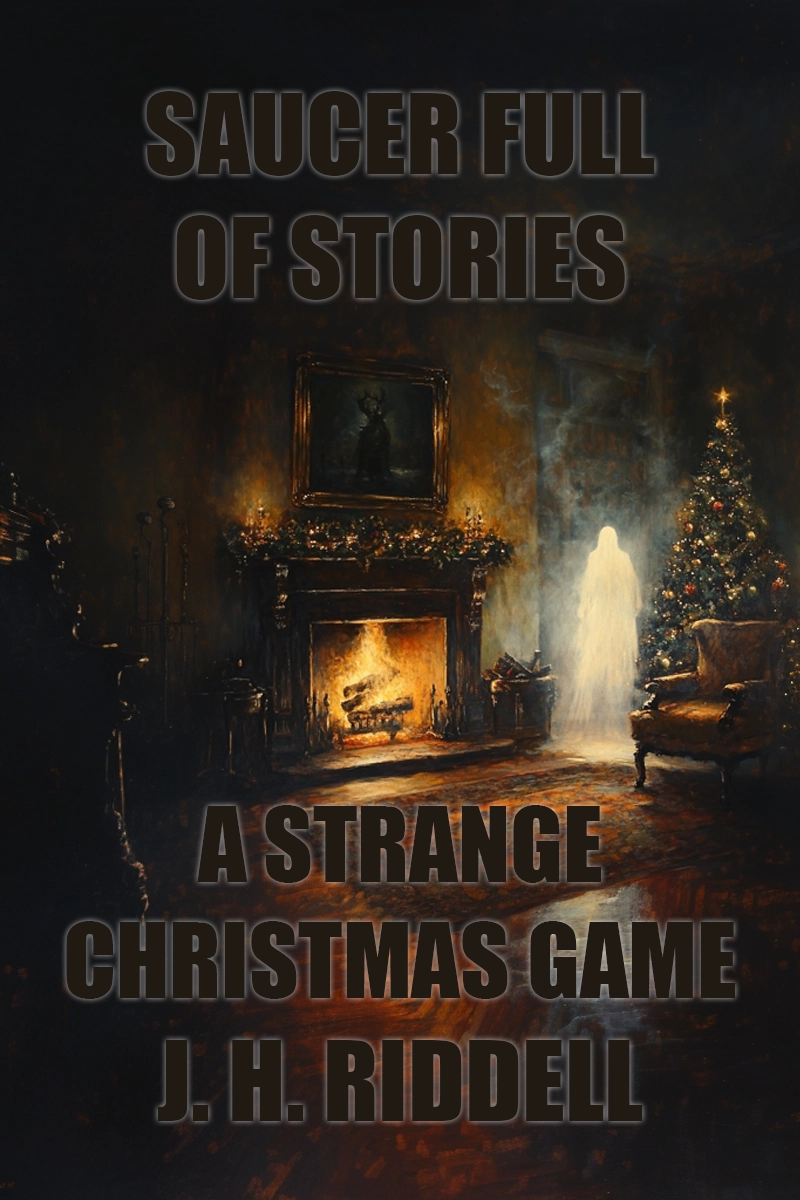
In A Strange Christmas Game, two siblings inherit an old family home only to uncover a ghostly mystery tied to their uncle’s tragic fate.
Gathered around the glow of the holiday season, our Saucer Full of Stories book club turned its attention to a time-honored Victorian ghost tale: J. H. Riddell’s “A Strange Christmas Game.” At first glance, the short story might strike modern readers as genteel, too mild for those accustomed to more intense fare. Yet beneath its surface, it offers glimpses of murder, family secrets, and just enough holiday unease to remind us why ghost stories once flourished at Christmastime.
A Pleasantly Haunting Atmosphere
“A Strange Christmas Game” unfurls in the classic English manor tradition. From the moment a pair of siblings inherit the old estate, the specter of secrets long buried begins to stir. One reader noted how the piece “was a nice Christmas ghost story,” lauding the gentler, more understated form of horror Riddell uses. The story’s key set piece, a mysterious game of cribbage being played by a figure from beyond, captured everyone’s imagination. One member of our book club admitted to liking the story in part because they, too, often play cribbage in real life. The seemingly wholesome image of a card game, tied to restless spirits, adds a playful yet haunting note.
Echoes of the Victorian Age
Many were struck by the overtly Victorian style. Long, flowing sentences; faintly archaic diction; a hint of moral caution running beneath. One reader compared it to hearing “a story told by a fireplace”, a style that in the 19th century might have been read aloud in a family parlor. There’s a certain formal poetry in the prose that is “specific without being crass, vague without being confusing”.
However, there are features that raise an eyebrow for today’s audiences. The main characters, a brother and sister share a household, an arrangement that was perfectly acceptable in its day but now can read as peculiar. Some even joked it felt straight out of a V.C. Andrews novel. As one observer quipped, “When such sibling arrangements go bad, we get ‘The Fall of the House of Usher.’”
Comparisons to Dickens and M.R. James
Reminiscent of 19th-century masters such as Dickens, and even more so of M.R. James, H.R. Ridell tells a sweeping tale of a relative who went missing one Christmas forty years ago.
MARK
Although J. H. Riddell may not be as widely recognized as Dickens or M.R. James, it’s easy to see her kinship with them. One comment likened the story to a slightly gentler version of M.R. James’s hallmark sense of dread. Another mused that with “more religious symbolism and no sister in this story,” it could have been an M.R. James work, albeit with less of James’s signature spooky atmosphere. Still, the consensus was that Riddell’s talent as a natural storyteller shines through.
The Mystery and Its Resolution
Central to a classic ghost story is the question, “Is it really a ghost, or could it be something else?” Riddell’s story upholds this tradition in full. Readers discover both a crime and the restless spirit behind it, a hallmark of Victorian storytelling. One reader remarked on the “extensive denouement,” pointing out that modern short fiction often skimps on conclusive resolutions, whereas older stories like Riddell’s take the time to restore cosmic order.
In that sense, the ghost’s reveal is not merely a fright but a puzzle. Explaining why the spirit is stuck and how the living characters can free them from the burden of the haunted inheritance. This need to put the specter’s soul at rest, to finally solve the long-standing injustice, resonates with the era’s desire for both spiritual and social propriety.
There’s an interesting resolution at the end—quite extensive for a short story, in my opinion. I’m so caught up in the moment with my short attention span that I often overlook resolutions, but this one adds a definite air of autobiography to the fiction.
CHAUNCEY
Language, Poetry, and the Joys of Ambiguity
Discussion also emerged about the richness of Riddell’s language. Some found it archaic, others enchanting. There’s a lyrical quality that invites re-reading, as the prose can “carry multiple meanings.” In that sense, the text feels layered, one part ghostly intrigue, another part window into an unfamiliar time. Over a century later, the story’s Victorian flourishes remain uniquely atmospheric, drawing a sharp contrast to modern fiction’s more direct style.
A Timeless Christmas Ghost Story
Ultimately, “A Strange Christmas Game” stands as a neat encapsulation of 19th-century festive haunting. It’s gentle enough to be read by candlelight on a cold December evening, yet slyly macabre in hinting at murder and secrets. Riddell’s writing might not shock contemporary readers the way modern horror can. It still offers a glimpse into a world where the living and dead blur in the hush of Christmas night.
I liked “A Strange Christmas Game” not least because Jan and I play cribbage a lot. I usually lose, but we still have a good time.
LOTHAR
For those who love their holiday reading to include a bit of suspense and a dash of gothic intrigue, “A Strange Christmas Game” provides a satisfying reminder of why the Victorians found ghost stories so captivating this time of year. With its haunting final revelations, it sets the bar for short, snappy ghost tales that still manage to leave the fireside crackling after the story’s done.
Interested in more Victorian-era chills? Some of our members recommend classic BBC ghost story adaptations, especially those aired on Christmas Day. In the meantime, whether your Christmas includes a friendly cribbage game or not, this little gem might be perfect on a cozy winter evening.
Up Next: “The Jar” by Ray Bradbury
Get ready to swap Victorian ghosts for something decidedly more surreal. Next in our Saucer Full of Stories rotation is Ray Bradbury’s unsettling classic, “The Jar.” Expect to encounter a curious container whose strange contents seem to reflect the darkest corners of human imagination.
Date Modified: 01-05-2025